Finding an Aspen practicum site and preceptor in Alabama
An Aspen placement in Alabama is project-based specialty or leadership work completed with an approved site and qualified preceptor. It is not a nurse practitioner clinical rotation because Aspen University currently offers no nurse practitioner tracks.
Get matched, free
Tell us your program and we’ll start the search. No payment until you’re matched.
What an Alabama placement should accomplish
The right setting depends on the academic program and the problem the student plans to address. Aspen MSN students select Administration and Management, Forensic Nursing, Informatics, Nursing Education, or Public Health. Each specialty has a 120-hour practicum. A Birmingham hospital education department might fit Nursing Education, while a Montgomery public-health office may suit a population-focused project. Informatics students could examine workflow or documentation with a health-system technology team, and Administration students may work with quality, operations, or nursing leadership.
These are structured learning projects, not extra work shifts and not NP patient-care rotations. The student should be able to explain the proposed project, the professional activities involved, the site resources required, and why the preceptor's background matches the specialty. That explanation gives both the prospective site and Aspen's Office of Field Experience, or OFE, a concrete plan to assess.
The Alabama Board of Nursing and Aspen approval have different roles
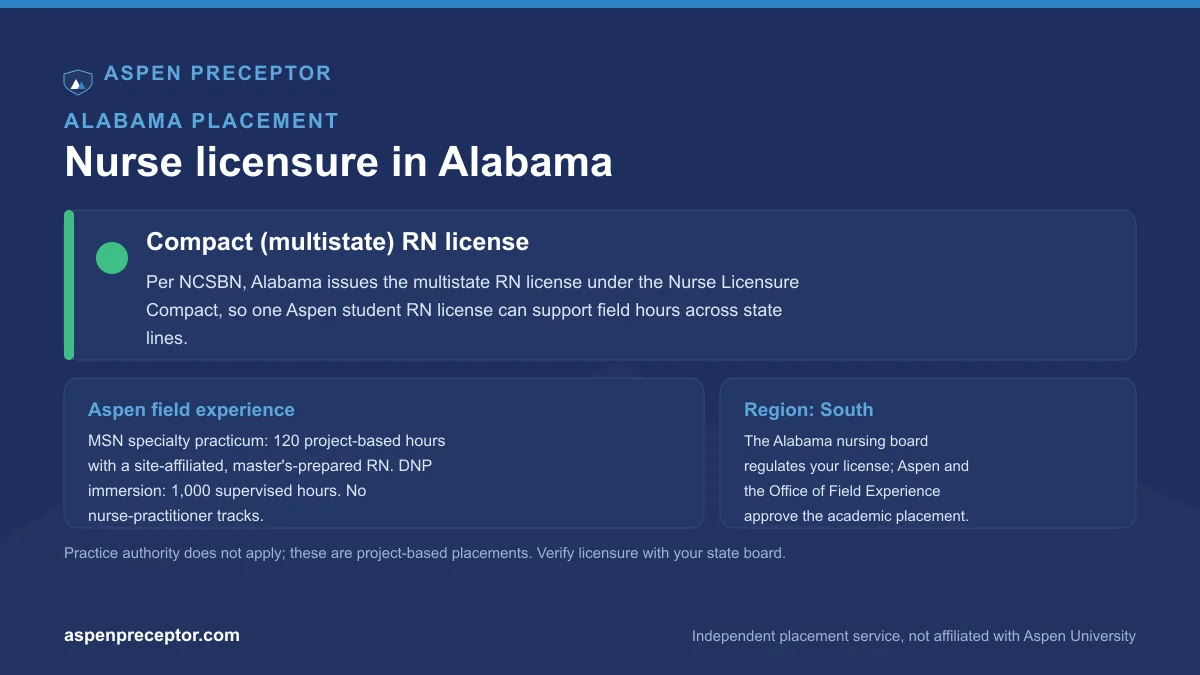
The Alabama Board of Nursing regulates nursing licenses and nursing practice in the state. Students and proposed RN preceptors can use its official resources when they need license or practice information. The Board does not approve an Aspen academic placement, select the student's project, or issue an Aspen approval letter.
Aspen and OFE make the academic decision. A proposed preceptor should be a site-affiliated RN who holds a master's degree and has relevant specialty expertise. The student's own license and the preceptor's license must remain appropriate for their roles at the site. A facility may also impose compliance, privacy, orientation, or project-review requirements beyond Aspen's paperwork, so those questions belong on the early planning list.
Where Alabama students can focus the search
Birmingham has large health systems, academic health operations, staff-development teams, informatics departments, and quality offices. Huntsville offers hospital, technology, and community-health possibilities that may align with informatics or administration. Montgomery can be useful for state-level public-health and organizational work. Mobile adds coastal health systems, community agencies, and education settings, while Tuscaloosa and Auburn may offer academic or staff-learning environments.
A practical search begins with the project function, not a long list of facility names. Nursing Education students can ask who manages competency, onboarding, simulation, or continuing education. Public Health students can look at county health work, prevention programs, or community needs assessment. Forensic Nursing students may explore correctional health, trauma programs, advocacy services, or other settings where a qualified nurse can supervise work relevant to the specialty. No setting is automatically acceptable simply because it operates in health care.
- Ask whether the department can support the proposed project throughout the required term.
- Confirm that a master's-prepared, site-affiliated RN has the right expertise and capacity to precept.
- Describe any direct-care activity clearly when the specialty requires it.
- Check whether the organization has its own project, privacy, or data-use review.
Build the hours around the Aspen course sequence
For MSN specialties, the practicum total is 120 hours. Administration and Management divides those hours between N550 at 40 hours and N586AM at 80 hours. Forensic Nursing, Nursing Education, and Public Health include at least 20 direct-care hours within the 120. Informatics and Administration do not carry that direct-care minimum. RN-to-MSN students also complete undergraduate field experience before the graduate practicum, so the 120-hour MSN component is not their only field requirement.
RN-to-BSN planning requires special attention to the current catalog. The course breakdown is N492 at 30 hours, N493 at 80 hours, and N496 at 10 hours. Those figures add to 120, while the Aspen catalog heading says 110. The student should confirm which catalog and course requirements apply rather than assuming a total. Our RN-to-BSN field experience guide explains the discrepancy without treating any preceptor rule as categorical.
Paperwork comes before the first hour
A viable Alabama contact is only the beginning. Approval materials can include a Site Affiliation or Practicum Site Agreement, signed Preceptor Agreement, preceptor CV and license report, student license report, Student Profile, and student CV. OFE assists with placement questions, approvals, and alternative locations. Many students start with their workplace, but a familiar employer still needs the applicable review.
Do not begin hours until the applicable Practicum Approval Letter has been issued. Once approved, record the required activity and reports in ProjectConcert. Keeping a course calendar, preceptor check-in schedule, and project milestone list together helps the student avoid accumulating time that does not clearly support the approved plan. The practicum hours and approval guide provides a fuller workflow.
In-person and virtual practicum routes in Alabama
Aspen DNP students complete 1,000 supervised immersion hours in eight 125-hour courses. Aspen may approve and bank up to 500 verified prior precepted hours. An Alabama DNP site needs an on-site, doctoral-prepared, site-affiliated preceptor with relevant leadership and project expertise. IRB approval is required before data collection or analysis, so project access and review steps should be discussed before the term begins.
Our service offers Aspen students in-person and virtual practicum routes in Alabama. Before starting, confirm the proposed format, site, preceptor, and planned activities with Aspen and the Office of Field Experience for your individual program and course. DNP students should also follow Aspen's current on-site preceptor and project approval requirements.
Help with an Alabama preceptor search
If a workplace option is unavailable or the specialty match is weak, our independent service can help source a qualified Alabama contact and organize the information needed for review. We cannot guarantee placement or Aspen approval, and students pay only when matched. Start with a free placement review so we can assess the specialty, city, course timing, and proposed project. Pricing details remain on the cost page.
Frequently asked questions
Does Alabama approve my Aspen practicum site?
The Alabama Board of Nursing regulates nursing licenses and practice. Aspen and its Office of Field Experience decide whether the proposed academic site, preceptor, project, and documents meet program requirements.
Can I complete my Aspen practicum at my Alabama workplace?
Many students explore their workplace. The department, project, and preceptor still need to fit the specialty, and the site must complete any required Aspen and internal review before hours begin.
How many hours does an Aspen MSN student complete?
Each Aspen MSN specialty has a 120-hour practicum. Administration splits the hours between N550 and N586AM, while several specialties include at least 20 direct-care hours within the total.
Does your service offer in-person and virtual practicum routes in Alabama?
Our service offers Aspen students in-person and virtual practicum routes in Alabama. Before starting, confirm the proposed format, site, preceptor, and planned activities with Aspen and the Office of Field Experience for your individual program and course. DNP students should also follow Aspen's current on-site preceptor and project approval requirements.
Get your Aspen practicum handled.
Tell us your program and specialty. We’ll map your field-experience requirement and start the search, in person or virtual. No payment until you’re matched.