Using Your Own Workplace for Your Aspen Practicum
Yes, you can usually complete your Aspen University practicum where you already work: students are responsible for securing their own placement, and in practice many arrange their field experience through their current employer. This guide from our clinical placement service covers when your workplace fits, who can and cannot sensibly precept you there, and the exact approvals to clear with the Office of Field Experience before your practicum course begins.
Get matched, free
Tell us your program and we’ll start the search. No payment until you’re matched.
Can I do my Aspen practicum where I work?
In practice, yes: Aspen leaves the job of securing a practicum site and preceptor to the student, and the student’s own employer is the single most common answer. The Office of Field Experience (OFE) assists with identifying and approving a site and preceptor, but it does not hand you either one, so most students start the search with the facility they already know. You already hold a badge there, the compliance relationship exists, and you likely know which colleagues hold graduate degrees.
The workplace route fits every Aspen program that needs a placement. For the MSN and the graduate portion of the RN-to-MSN, that means the 120-hour, specialty-matched practicum. For the DNP, it means access to a clinical site and a preceptor to support the 1,000 clinical-practice immersion hours, of which up to 500 previously precepted hours may be banked. The RN-to-BSN community-health field hours do not require a preceptor at all, so this guide matters most for MSN, RN-to-MSN, and DNP students.
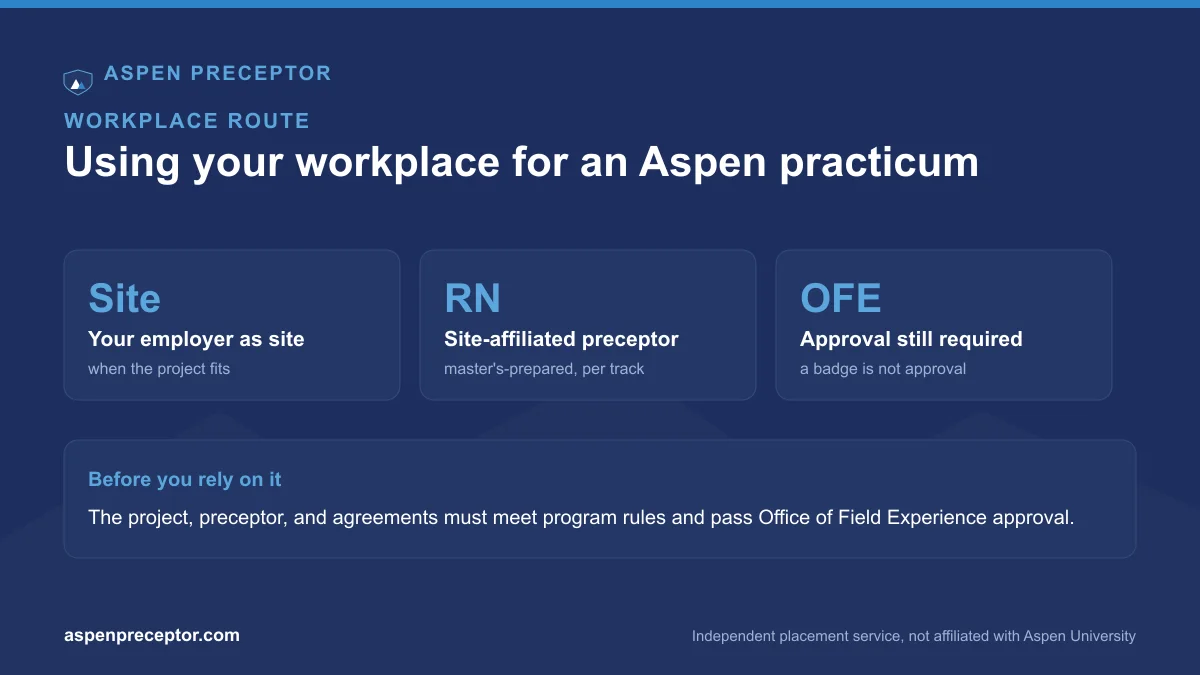
One honest caution before you count on it: working somewhere does not make it an approved practicum site. Your employer still has to match your specialization, your proposed preceptor still has to qualify, and the paperwork still has to produce a Practicum Approval Letter before the course begins. The rest of this page walks each of those gates.
Who can precept me at my own workplace?
The same person who could precept you anywhere else: a Registered Nurse who is affiliated with the practicum site and holds a master’s degree with expertise relevant to your MSN specialization. At your own facility that usually means a nurse educator, a unit or department leader, an informaticist, or a public-health or quality colleague, someone whose graduate preparation lines up with your track.
Now the boundary question everyone asks: can your boss be your preceptor? Aspen’s public materials do not publish a formal conflict-of-interest list the way some universities do, so treat what follows as prudent practice to confirm against your current MSN Handbook and with OFE at ofe@aspen.edu, not as a published Aspen rule. Many peer universities formally bar students from precepting under their direct supervisor or manager, and the logic travels: your preceptor evaluates your practicum performance, and that evaluation should not be tangled up with the person who writes your annual review.
Whatever Aspen confirms for your cohort, these boundaries keep a workplace practicum clean:
Sensible workplace boundaries
- Pick a preceptor outside your reporting line where you can. A master’s-prepared RN from another unit or department keeps the evaluation honest and is the norm peer schools require.
- Separate practicum work from paid duties. Your 120 hours are project-based field experience tied to your specialization, not a relabeling of the shift you were already working.
- Disclose the relationship. The Preceptor Agreement and Student Profile are where the arrangement goes on record; surprises discovered later are what stall approvals.
- Confirm the current rule before you commit. One email to ofe@aspen.edu describing your proposed site and preceptor costs nothing and prevents a failed approval.
Does my workplace match my specialization?
Only if the setting fits the site types Aspen’s MSN Handbook ties to your track, so check the list before you nominate it. Forensic Nursing points to emergency departments, law enforcement agencies, correctional facilities, medical examiner’s offices, and the court system. Public Health points to local and state health departments and school nurse offices. Nursing Education points to staff education departments and continuing-education companies. Informatics points to ambulatory/outpatient and HIM informatics departments. Administration & Management points to acute-care and skilled-nursing facilities, Magnet facilities, and professional organizations.
A hospital employer can often host several of these tracks, a small clinic fewer. Remember also that the Nursing Education, Forensic Nursing, and Public Health tracks require a minimum of 20 direct-care hours within the 120, so your workplace plan has to leave room for direct-care experience, not just conference-room project time. The specialties overview breaks down each track if you are still choosing.
What approvals do I need before I start?
The same four documents every Aspen practicum needs, ending in a Practicum Approval Letter issued before your practicum course begins; being an employee does not skip a single step. In order, the workplace version looks like this:
The approval path at your employer
- Confirm the fit informally first. Your specialization matches the setting, and your proposed preceptor is a master’s-prepared RN affiliated with the site.
- Practicum Site Agreement. Your employer signs on as the practicum site. Route it early; hospital legal departments move at their own pace even for their own employees.
- Preceptor Agreement. Your preceptor formally accepts the role and its evaluation duties.
- Student Profile and Student Performance Evaluation. Your side of the record, plus the evaluation instrument your preceptor will complete.
- Practicum Approval Letter. OFE issues it once the pieces are in order, and you must have it before the practicum course begins.
- Log hours in ProjectConcert. Once underway, your record includes a signed preceptor audit report and the Week-7 site and preceptor evaluations.
What if my workplace falls through?
You still have two working routes: OFE can help you explore alternative locations, and we can run the search for you. Employers decline for ordinary reasons, no master’s-prepared RN in the right specialty, a legal office that will not sign the Practicum Site Agreement in time, or a setting that simply does not match your track. None of that has to cost you a term.
As an independent clinical placement service, we source a qualified, specialty-matched preceptor and an approvable site on your behalf, then help organize the agreements so the Practicum Approval Letter arrives before your course does. If travel or local supply is the obstacle, our virtual practicum service arranges a remote preceptor and experience where your program permits. Start with find a preceptor, see what our service costs, or contact us and tell us your specialization and start date. We assist rather than guarantee, and you pay only when you are matched.
Frequently asked questions
Can I complete my Aspen practicum at my current job?
Usually, yes. OFE assists with identifying and approving sites and preceptors, documentation, and alternative locations, while many students use their employer. Your workplace must still match your specialization’s approved site types, your preceptor must be a master’s-prepared RN affiliated with the site, and OFE must issue your Practicum Approval Letter before the course begins.
Can my manager or supervisor be my preceptor?
Aspen’s public materials do not publish a formal rule, so confirm with OFE and your current MSN Handbook. Prudent practice, and the written policy at many peer universities, is to precept under a master’s-prepared RN outside your direct reporting line so the practicum evaluation stays independent of your employment.
Do workplace practicum hours count differently?
No. Hours are logged in ProjectConcert exactly as at any other site, with a signed preceptor audit report and Week-7 site and preceptor evaluations. The 120-hour requirement, and the 20 direct-care hours minimum for the Nursing Education, Forensic Nursing, and Public Health tracks, apply unchanged.
Does being an employee speed up OFE approval?
It can shorten the search, since the site relationship already exists, but it skips no steps. The Practicum Site Agreement, Preceptor Agreement, Student Profile, and Student Performance Evaluation are all still required before the Practicum Approval Letter is issued.
What if my employer says no?
It happens often, and it is recoverable. OFE can help explore alternative locations, and we can source a specialty-matched preceptor and site for you, in person or through our virtual practicum service where your program permits. You pay only when a placement is secured.
Get your Aspen practicum handled.
Tell us your program and specialty. We’ll map your field-experience requirement and start the search, in person or virtual. No payment until you’re matched.