Aspen University RN-to-MSN: The Bridge Path and Its Practicum
Aspen University’s RN-to-MSN bridge lets registered nurses without a bachelor’s degree move directly toward a master’s, no separate BSN required along the way. This page explains how the bridge is structured, where the practicum fits, and how an independent service can help you secure the preceptor that stands between you and graduation.
Get matched, free
Tell us your program and we’ll start the search. No payment until you’re matched.
What the RN-to-MSN bridge actually is
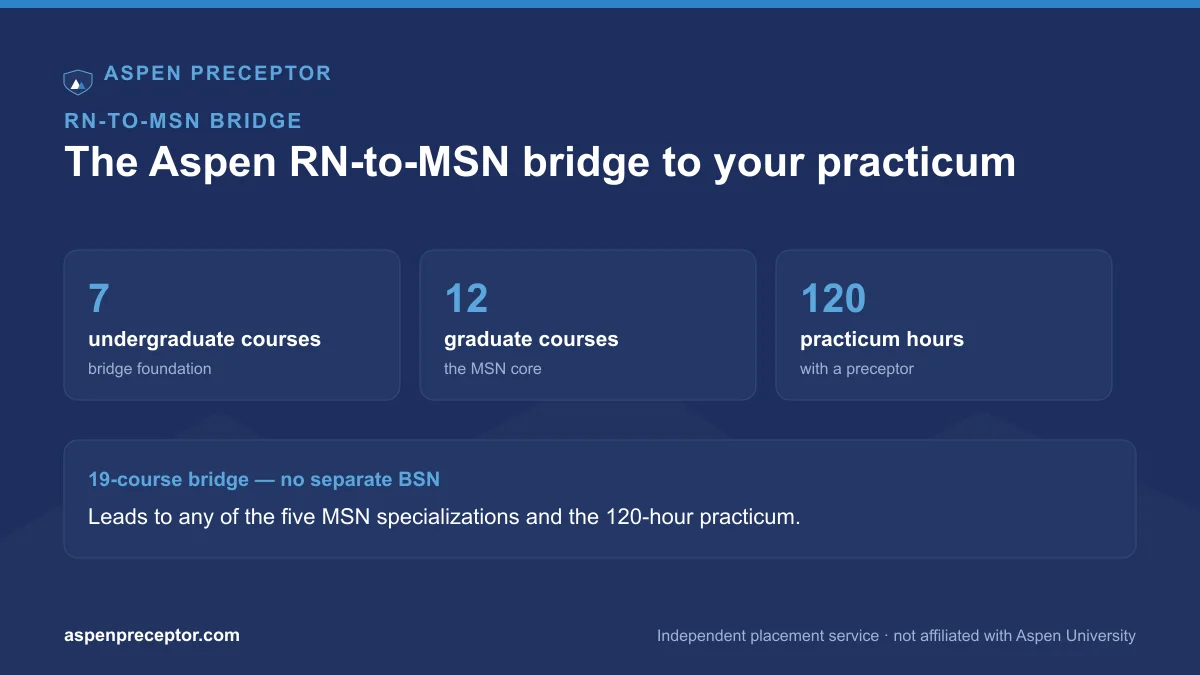
Aspen University’s RN-to-MSN program is a bridge designed for registered nurses who hold a diploma or associate degree but not a bachelor’s. Rather than completing a standalone BSN first and then enrolling in a master’s, you complete one continuous pathway of 19 courses, 7 at the undergraduate level and 12 at the graduate level. The undergraduate courses build the foundation; the graduate courses are the same master’s-level coursework taken in the standard MSN.
Because it folds two levels of study into a single track, the bridge takes roughly four years to complete. There is no separate BSN degree conferred along the way; the program is structured so that your prior RN credential and the seven undergraduate courses bring you to the point where graduate study begins. The result is the same master’s outcome as the direct-entry MSN, reached by a route built for nurses already working at the bedside.
Aspen’s MSN nursing program is accredited by the Commission on Collegiate Nursing Education (CCNE), and Aspen University is institutionally accredited by the Distance Education Accrediting Commission (DEAC), a national/distance accreditor recognized by the U.S. Department of Education and CHEA. We are an independent service; we simply help students navigate the placement step.
The five specializations and the 120-hour practicum
The graduate portion of the RN-to-MSN bridge carries the same five specializations as the direct MSN: Forensic Nursing, Informatics, Administration & Management, Nursing Education, and Public Health. Whichever you choose shapes both your coursework and where you will eventually complete field hours. You can read more on the specialties overview or go straight to a track such as Nursing Education, Informatics, Public Health, Administration & Management, or Forensic Nursing.
Every specialization requires a 120-hour practicum, and every practicum requires a preceptor. For Aspen’s purposes, a preceptor is a Registered Nurse affiliated with the practicum site who holds a master’s degree with expertise relevant to your specialty. For the Nursing Education, Forensic Nursing, and Public Health tracks, a minimum of 20 of those 120 hours must be direct-care hours. This is project-based, specialty-matched field experience and quality-improvement work, not nurse-practitioner-style direct patient-care rotations. Aspen does not offer NP tracks.
Where you complete those hours depends on your specialty. Forensic students work in settings like emergency departments, law enforcement agencies, correctional facilities, medical examiner’s offices, and the court system. Public Health students serve in local or state health departments and school nurse offices. Nursing Education students work in staff education departments and continuing-education companies; Informatics students in ambulatory, outpatient, and health-information-management informatics departments; and Administration & Management students in acute-care or skilled-nursing facilities, Magnet facilities, and professional organizations.
How the practicum gets approved
The practicum sits inside Aspen’s formal process. Hours are logged in ProjectConcert and supported by a signed preceptor audit report and Week-7 site and preceptor evaluations. Before a practicum course begins, you must complete a Practicum Site Agreement, a Preceptor Agreement, a Student Profile, and a Student Performance Evaluation, which together lead to a Practicum Approval Letter.
Aspen’s Office of Field Experience (OFE) assists with identifying and approving a site and preceptor, handling documentation, and considering alternative locations, but it does not guarantee placement, and students remain responsible for securing their own. Many nurses use their own workplace. You can review these steps in more detail on our practicum hours and approval page and our overview of the Office of Field Experience.
Where we help, and how you pay
The genuine difficulty for bridge students is rarely the coursework. It is the preceptor search. Students regularly report that the hunt drags on for months, because Aspen leaves it largely to you. That single bottleneck can stall a four-year program at the finish line.
That is exactly where we work. As an independent service, we source a qualified, specialty-matched preceptor and an approved field-experience site for your chosen MSN specialization. We offer this two ways: physical placement matching, a real preceptor and an approved in-person site, or our virtual practicum service, a remote preceptor and virtual experience. We assist with the process; we never promise an outcome Aspen alone controls.
If you are weighing the bridge, start by exploring the programs we support or tell us about your specialty on the find-a-preceptor page. There is no risk in reaching out: you pay only when we match you with a preceptor.
Frequently asked questions
Do I earn a BSN during the RN-to-MSN bridge?
No. The bridge does not confer a separate BSN. You complete one continuous pathway of 19 courses, 7 undergraduate and 12 graduate, that leads directly to the master’s, without a standalone bachelor’s degree along the way.
How long does the RN-to-MSN bridge take?
It takes roughly four years to complete, since it combines undergraduate foundation courses with the full graduate MSN coursework in a single track.
Does the bridge require a practicum and preceptor?
Yes. Every specialization in the program requires a 120-hour practicum, and that practicum requires a preceptor, a Registered Nurse affiliated with the site who holds a master’s degree relevant to your specialty. For the Nursing Education, Forensic Nursing, and Public Health tracks, at least 20 of those hours must be direct-care hours.
Can you guarantee my placement?
No. We assist with sourcing a qualified, specialty-matched preceptor and an approved site, in person or virtual, but we never guarantee placement, Aspen’s Office of Field Experience approves the final arrangement. We are an independent service, and you pay only when we match you.
Get your Aspen practicum handled.
Tell us your program and specialty. We’ll map your field-experience requirement and start the search, in person or virtual. No payment until you’re matched.