Aspen Practicum Hours & the Approval Process, Step by Step
If you’re starting an Aspen University nursing practicum or field experience, the hour requirements and paperwork can feel confusing before you even begin. This guide lays out how many hours each program requires, the exact forms you’ll submit, how the Practicum Approval Letter works, and how hours get logged, so you know what’s ahead before your practicum course begins.
Get matched, free
Tell us your program and we’ll start the search. No payment until you’re matched.
How many hours your program requires
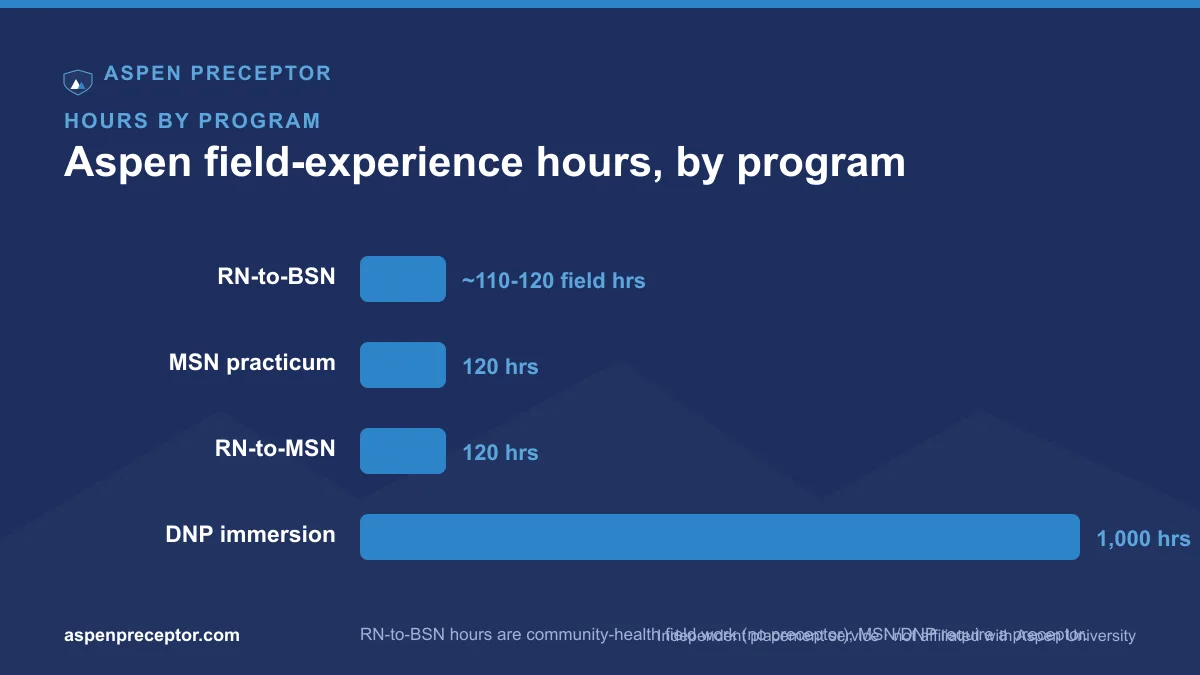
Hour requirements at Aspen differ by program, so the first step is knowing which target applies to you. Getting this right early prevents surprises once your practicum course opens.
For the MSN, the practicum requires 120 hours under a preceptor. The Nursing Education, Forensic Nursing, and Public Health tracks additionally require a minimum of 20 direct-care hours within those 120. Practicum coursework runs through courses N550, N552, and N586 and is graded Satisfactory/Unsatisfactory. The RN-to-MSN path follows the same five specializations and the same 120-hour practicum, reached after its sequence of undergraduate and graduate courses.
For the RN-to-BSN, you complete roughly 110-120 community-health field hours rather than a preceptored practicum, N492 Community Health I (30 hours), N493 Community Health II (80 hours), and N496 Nursing Leadership (10 hours). No preceptor is required; this is community and public-health field work, not hospital clinical rotations, and the hours are documented and approved before course completion.
For the DNP, you complete 1,000 clinical-practice immersion hours, with up to 500 previously precepted hours bankable. The DNP requires access to a clinical site and a preceptor, a DNP Project / Capstone, and DNP880 requires submitting and obtaining Aspen University IRB approval.
Who counts as a preceptor
For MSN and RN-to-MSN practicums, your preceptor must be a Registered Nurse affiliated with the practicum site who holds a master’s degree with expertise relevant to your specialty. The right setting depends on your track.
Aspen’s MSN Handbook outlines site types by specialty: Forensic Nursing fits emergency departments, law enforcement agencies, correctional facilities, medical examiner’s offices, and the court system; Public Health fits local/state health departments and school nurse offices; Nursing Education fits staff education departments and continuing-education companies; Informatics fits ambulatory/outpatient and HIM informatics departments; and Administration & Management fits acute-care and skilled-nursing facilities, Magnet facilities, and professional organizations.
This work is project-based, specialty-matched field experience, not direct patient-care clinical rotations. You can read more on each track on our specialties pages. And if you know a master’s-prepared RN who could mentor Aspen students, point them to become a preceptor.
The forms, in order
Aspen’s Office of Field Experience (OFE) assists with identifying and approving a site and preceptor, documentation, and alternative locations, but it does not guarantee placement, students are responsible for securing their own placement, and many use their workplace. You can reach OFE at ofe@aspen.edu, and we cover how it works in detail on our Office of Field Experience page.
Before your practicum course begins, you submit a set of required forms: the Practicum Site Agreement, the Preceptor Agreement, your Student Profile, and the Student Performance Evaluation. These establish that your site, your preceptor, and you are all in order for the specialty you’re pursuing.
Submit these accurately and early. The single most common reason a practicum start slips is paperwork that wasn’t completed and approved in time.
The Practicum Approval Letter
Once your forms are reviewed and accepted, Aspen issues a Practicum Approval Letter. This letter is the gate: it must be obtained before the practicum course begins. Without it, you cannot start logging hours toward your requirement.
Treat the Approval Letter as your milestone. Work backward from your course start date and build in time for site and preceptor confirmation, since lining up a qualified, specialty-matched preceptor is often the slowest part of the process.
Logging your hours in ProjectConcert
After approval, your hours are logged in ProjectConcert. Documentation includes a signed preceptor audit report and Week-7 site and preceptor evaluations, which together verify that the hours you completed meet your program’s requirements.
Keep your logging current rather than batching it at the end. Consistent records make the final preceptor audit report and Week-7 evaluations straightforward and help you confirm you’ve hit your 120, 1,000, or community-health field target. For more, see our specialties pages and frequently asked questions.
Where the search slows down, and how we help
The paperwork and logging are predictable. The hard part, for most Aspen students, is the part Aspen leaves to you: finding a qualified, specialty-matched preceptor and an approved site. Students regularly report preceptor searches dragging on for months because the search is theirs to run.
That’s exactly what we do. aspenpreceptor.com is an independent service that sources a real preceptor and an approved field-experience site for you, in person or virtual, and walks you through Aspen’s process. We assist; we don’t guarantee placement. We offer both physical placement matching and a virtual practicum service across all programs.
If the search is what’s standing between you and your start date, let us take it on. You find a preceptor through us and pay only when you’re matched, reach out any time on our contact page.
Frequently asked questions
How many practicum hours does the Aspen MSN require?
The Aspen MSN practicum requires 120 hours under a qualified preceptor. The Nursing Education, Forensic Nursing, and Public Health tracks also require a minimum of 20 direct-care hours within those 120. Practicum runs through courses N550, N552, and N586, graded Satisfactory/Unsatisfactory.
Does the RN-to-BSN require a preceptor?
No. The RN-to-BSN involves roughly 110-120 community-health field hours across N492 Community Health I (30 hours), N493 Community Health II (80 hours), and N496 Nursing Leadership (10 hours). It is community and public-health field work, not hospital clinical rotations, and no preceptor is required.
What is the Practicum Approval Letter and when do I need it?
After your required forms, the Practicum Site Agreement, Preceptor Agreement, Student Profile, and Student Performance Evaluation, are reviewed and accepted, Aspen issues a Practicum Approval Letter. You must obtain it before your practicum course begins; it is required before you can start logging hours.
Where are practicum hours logged?
Hours are logged in ProjectConcert. Documentation includes a signed preceptor audit report and Week-7 site and preceptor evaluations that verify your completed hours meet your program's requirements.
How many hours does the Aspen DNP require?
The DNP requires 1,000 clinical-practice immersion hours, with up to 500 previously precepted hours bankable. It requires access to a clinical site and preceptor, a DNP Project / Capstone, and DNP880 requires obtaining Aspen University IRB approval.
Can you guarantee my placement?
No, and neither does Aspen's Office of Field Experience. We are an independent service. We assist by sourcing a real, specialty-matched preceptor and an approved site, in person or virtual, and you pay only when you're matched.
Get your Aspen practicum handled.
Tell us your program and specialty. We’ll map your field-experience requirement and start the search, in person or virtual. No payment until you’re matched.