How to plan an Aspen nursing placement in Alaska
In Alaska, an Aspen practicum is a supervised specialty project or DNP immersion based at an approved organization. It should not be presented as an NP clinical rotation because Aspen currently has no nurse practitioner tracks.
Get matched, free
Tell us your program and we’ll start the search. No payment until you’re matched.
Start with geography and a workable project
Alaska's distances make a clear project scope especially important. A student in Anchorage may have access to health-system education, informatics, administration, public-health, and quality teams in one metropolitan area. Fairbanks can support hospital, community-health, university, and population-focused work. Juneau may be relevant for public-health or organizational projects, while the Mat-Su Valley, Kenai Peninsula, and regional or tribal health organizations can open different possibilities when the site has an appropriate department and preceptor.
The placement is not defined by the building alone. It is defined by the approved work, the learning objectives, and the qualified RN supervising it. Aspen's MSN specialties are Administration and Management, Forensic Nursing, Informatics, Nursing Education, and Public Health. Before approaching a site, the student should be ready to describe which specialty applies, what problem or process the project addresses, and what participation the department and preceptor would need to provide.
What Alaska's nursing regulator does
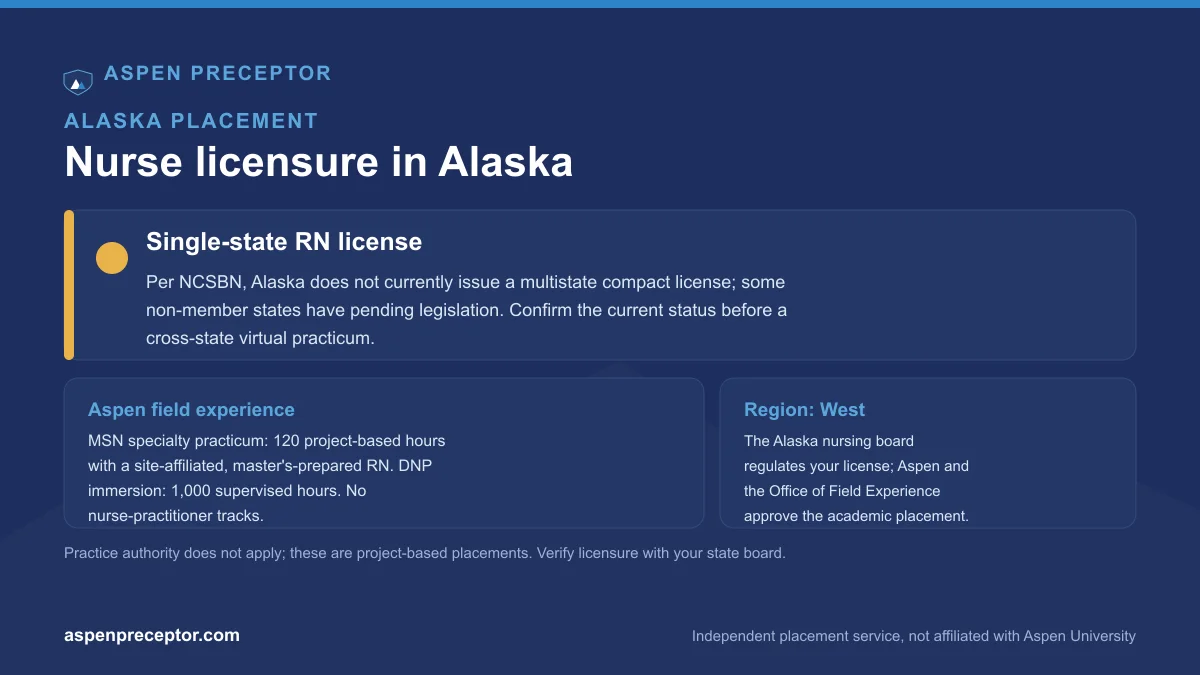
The Alaska Board of Nursing governs nursing practice and makes nursing licensing decisions in the state. Its official site provides nursing statutes, regulations, license verification, scope resources, and guidance for education offered at a distance. Those regulatory functions matter when the student and proposed preceptor assess whether their professional roles are appropriate in Alaska.
The Board is not Aspen's academic placement office. Aspen University and the Office of Field Experience, or OFE, evaluate the proposed site, preceptor, documents, and project. The academic preceptor for an MSN practicum is a site-affiliated RN with a master's degree and expertise connected to the student's specialty. The site may impose additional orientation, data-access, compliance, or internal review rules.
Match the specialty to an Alaska setting
Nursing Education students might ask about staff development, competency programs, simulation, onboarding, or patient education. Informatics students can seek nursing informatics, clinical systems, health information, or workflow-improvement teams. Administration students may fit nursing operations, quality, safety, or leadership offices. Public Health students can consider local or regional programs that address prevention, community education, rural access, or population needs. Forensic Nursing requires a closer specialty match and may involve correctional health, trauma services, advocacy programs, or another setting with relevant nursing expertise.
In smaller communities, a promising contact may cover several functions. That can help if the proposed project remains specific and the preceptor has the necessary graduate preparation. It can also create scheduling or role conflicts, so ask who will actually supervise the work, how often meetings will occur, and whether the organization can support the full course period. Discuss whether in-person or virtual supervision fits the proposed work, then confirm the route with Aspen and OFE.
- Anchorage: health-system operations, education, informatics, and quality departments.
- Fairbanks: hospital education, community programs, and public-health work.
- Juneau: public-sector health and organizational project possibilities.
- Regional Alaska: community, tribal, and rural health settings where specialty fit and site capacity can be documented.
Convert the required hours into a calendar
Every Aspen MSN specialty includes a 120-hour practicum. For Administration and Management, N550 carries 40 hours and N586AM carries 80. Forensic Nursing, Nursing Education, and Public Health include at least 20 direct-care hours within the 120. Informatics and Administration do not have that direct-care minimum. A weather delay, travel limit, or changing rural schedule can affect an Alaska plan, so build buffer time into the calendar and agree on meeting and activity dates with the preceptor.
RN-to-MSN students complete undergraduate field experience before the graduate practicum. They should not describe the 120-hour graduate component as their only field obligation. RN-to-BSN students should confirm their current catalog requirements: N492 lists 30 hours, N493 lists 80, and N496 lists 10. Those course figures total 120, although Aspen's catalog heading says 110. Confirmation with Aspen is more reliable than choosing one number without context.
Secure approval before committing travel or time
OFE helps with placement questions, approval, documentation, and possible alternative locations. Many students first explore their employer, but an employer-based placement still needs academic approval. Materials can include a Site Affiliation or Practicum Site Agreement, signed Preceptor Agreement, the preceptor's CV and license report, the student's license report, a Student Profile, and the student's CV. A site may ask for its own agreement or project review as well.
The applicable Practicum Approval Letter must be in hand before hours begin. After the start, required time and reports are recorded in ProjectConcert. A simple tracker can connect each activity to a course objective, project milestone, and preceptor discussion. This is more useful than waiting until the end to reconstruct what happened. See Aspen practicum approval steps for the complete sequence.
DNP immersion needs an on-site Alaska preceptor
The Aspen DNP requires 1,000 supervised immersion hours across eight 125-hour courses. Up to 500 verified prior precepted hours may be approved and banked. The proposed Alaska site must have an on-site, doctoral-prepared, site-affiliated preceptor whose leadership and project expertise fit the work. IRB approval is required before data collection or analysis, and site-level project review may also be necessary.
Aspen students in Alaska can use our service for either an in-person or virtual practicum route. Ask Aspen and the Office of Field Experience to confirm the format, site, preceptor, and activities for your individual program and course before any hours begin. DNP students should follow Aspen's current on-site preceptor and project approval requirements.
When the local search is not producing a match
Alaska students may need a wider geographic or organizational search when their employer cannot support the project. Our independent service can source possible specialty-aligned contacts and help organize the information for review. Students pay only when matched. Request a free placement review with the program, Alaska location, project theme, and expected course date. Service pricing is kept on the cost page.
Frequently asked questions
Is an Aspen Alaska practicum an NP rotation?
No. Aspen currently offers no nurse practitioner tracks. Its Alaska placements are specialty project practicums, undergraduate field experiences, or DNP immersion work, depending on the student's program.
What credentials should an Aspen MSN preceptor have in Alaska?
The preceptor should be a site-affiliated RN with a master's degree and expertise relevant to the student's MSN specialty and proposed project. Aspen and OFE make the approval decision.
May I use my Alaska employer as the site?
It may be a practical starting point. The department, project, preceptor, and paperwork still require review, and the student should wait for the applicable approval letter before recording hours.
Does your service offer in-person and virtual practicum routes in Alaska?
Aspen students in Alaska can use our service for either an in-person or virtual practicum route. Ask Aspen and the Office of Field Experience to confirm the format, site, preceptor, and activities for your individual program and course before any hours begin. DNP students should follow Aspen's current on-site preceptor and project approval requirements.
Get your Aspen practicum handled.
Tell us your program and specialty. We’ll map your field-experience requirement and start the search, in person or virtual. No payment until you’re matched.