Planning project-based Aspen hours in Arkansas
Aspen students in Arkansas need an approved setting for specialty project work or DNP immersion, not an NP clinical rotation. Aspen University currently has no nurse practitioner tracks, so the site search should follow the student's specialty and project objectives.
Get matched, free
Tell us your program and we’ll start the search. No payment until you’re matched.
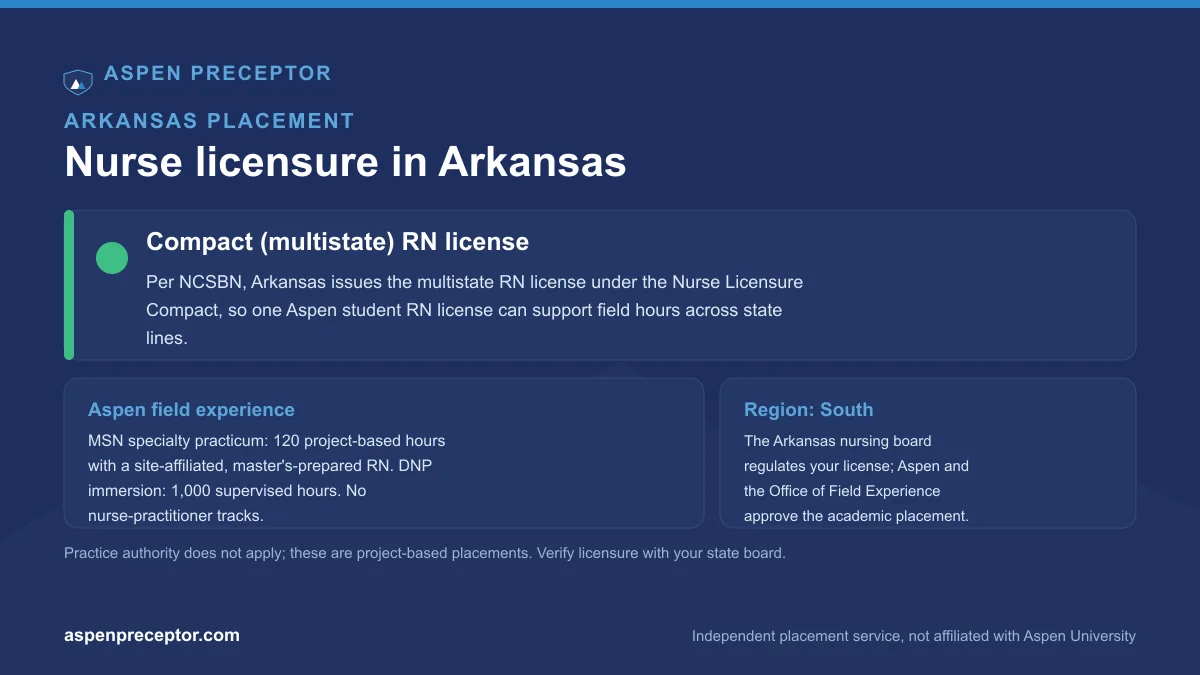
Know which decision belongs to which organization
The Arkansas State Board of Nursing is the state's official nursing regulator. It addresses licensure, nursing education and practice, license verification, and disciplinary matters within Arkansas law. Students should use the Board's current resources for state licensing and practice questions rather than treating a facility's human-resources answer as regulatory guidance.
Aspen University and its Office of Field Experience, or OFE, handle the academic placement decision. They review whether the proposed site, preceptor, documents, and project fit the student's program. The Board does not approve an Aspen project and OFE does not replace the Board's licensing role. Keeping that boundary clear makes questions easier to direct and prevents a promising site conversation from being mistaken for final academic approval.
Arkansas opportunities extend beyond one hospital unit
Little Rock offers health-system leadership, nursing education, informatics, quality, public-health, and academic settings. Northwest Arkansas, including Fayetteville, Springdale, Rogers, and Bentonville, adds growing health organizations, community programs, and operational teams. Fort Smith and Jonesboro may provide hospital, education, population-health, and quality settings. Pine Bluff, Conway, and smaller regional communities can be relevant when the department has the resources and graduate-prepared RN needed for the project.
Aspen MSN students choose Administration and Management, Forensic Nursing, Informatics, Nursing Education, or Public Health. An Administration student could study a workflow or quality process with nursing leadership. An Informatics project might focus on clinical documentation or system adoption with a nursing informatics team. Education could involve staff competency or patient teaching. Public Health may fit prevention or community outreach. Forensic Nursing requires a supervisor with specialty expertise and may align with correctional health, trauma, advocacy, or another appropriate service.
Screen the preceptor before exchanging forms
For an Aspen MSN practicum, the proposed preceptor is a site-affiliated RN with a master's degree and expertise relevant to the specialty. A respected nurse may still be the wrong academic match if the degree, site relationship, expertise, or available supervision does not fit. Ask about credentials, current role, project experience, availability across the course dates, and whether the organization permits the person to precept before sending a full packet.
The project should also be feasible at that specific Arkansas site. Confirm that the student can access the department, people, and nonrestricted information needed for the approved activities. If the work involves data, quality information, or a survey, ask what internal review is required. The student's academic plan does not override facility privacy, compliance, or project-governance rules.
- State the Aspen program and specialty accurately.
- Explain the project purpose and expected course dates.
- Give the correct hour total and any direct-care component.
- Ask who signs site agreements and how long internal review usually takes without promising a deadline.
Plan for the exact Aspen hour structure
Every Aspen MSN specialty has a 120-hour practicum. Administration and Management separates the work into N550 with 40 hours and N586AM with 80. Forensic Nursing, Nursing Education, and Public Health include at least 20 direct-care hours within the 120. Informatics and Administration do not carry that direct-care minimum. Students should design activities that satisfy the relevant specialty instead of filling a calendar with generic observation.
RN-to-MSN students first complete undergraduate field experience and then the 120-hour graduate practicum. For RN-to-BSN students, the published course breakdown is N492 at 30 hours, N493 at 80, and N496 at 10. The sum is 120, although the catalog heading says 110. Confirm the applicable catalog and requirements with Aspen before building a schedule. The RN-to-MSN guide can help separate undergraduate and graduate field work.
Move from an Arkansas yes to an Aspen approval letter
OFE assists with questions, approvals, and alternative locations, and many students begin by exploring their workplace. A positive response from a manager is still preliminary. The approval packet can include a Site Affiliation or Practicum Site Agreement, signed Preceptor Agreement, preceptor CV and license report, student license report, Student Profile, and student CV. The site may have its own agreement, compliance checklist, or review channel.
Hours begin only after the student receives the applicable Practicum Approval Letter. Approved time and required reports are recorded in ProjectConcert. Keep copies of the approved scope, course objectives, and scheduled preceptor meetings so entries can connect activity to purpose. Students who want a step-by-step view can use the hours approval guide.
DNP projects need continuity and formal review
Aspen DNP students complete 1,000 supervised immersion hours across eight 125-hour courses. Aspen may approve up to 500 verified prior precepted hours to be banked. The Arkansas site must provide an on-site, doctoral-prepared, site-affiliated preceptor with relevant leadership and project expertise. Because the work extends across multiple courses, the student should ask whether the site and preceptor can remain involved beyond one term.
IRB approval is required before any data collection or analysis. A facility may also require its own research, quality, or project determination. In-person and virtual practicum routes are both available through our service for Aspen students in Arkansas. Each student should confirm the proposed format, site, preceptor, and activities with Aspen and the Office of Field Experience before starting. DNP students must also follow Aspen's current on-site preceptor and project approval requirements.
A focused way to widen the Arkansas search
When workplace and direct outreach do not produce a specialty-aligned RN, our independent placement service can help source a potential Arkansas match and organize the facts for Aspen review. We cannot guarantee either a placement or university approval. Students pay only when matched. Submit a free placement review with the city, specialty, course timing, and project direction. Service pricing stays on the cost page.
Frequently asked questions
Is an Arkansas Aspen placement a nurse practitioner rotation?
No. Aspen currently offers no NP tracks. These placements involve specialty projects, undergraduate field experience, or DNP immersion work according to the student's program.
Does OFE help Arkansas students find a site?
OFE assists with placement questions, approvals, documentation, and alternative locations. That assistance does not guarantee a site, and the proposed arrangement still needs formal approval.
What makes an Arkansas MSN preceptor eligible?
The person should be a site-affiliated RN with a master's degree and expertise relevant to the Aspen specialty. Aspen reviews the full preceptor and site proposal.
When can I start logging Arkansas practicum hours?
Begin only after receiving the applicable Aspen approval letter. Once approved, record hours and required reports in ProjectConcert according to the course process.
Get your Aspen practicum handled.
Tell us your program and specialty. We’ll map your field-experience requirement and start the search, in person or virtual. No payment until you’re matched.