Build a California practicum around your Aspen specialty
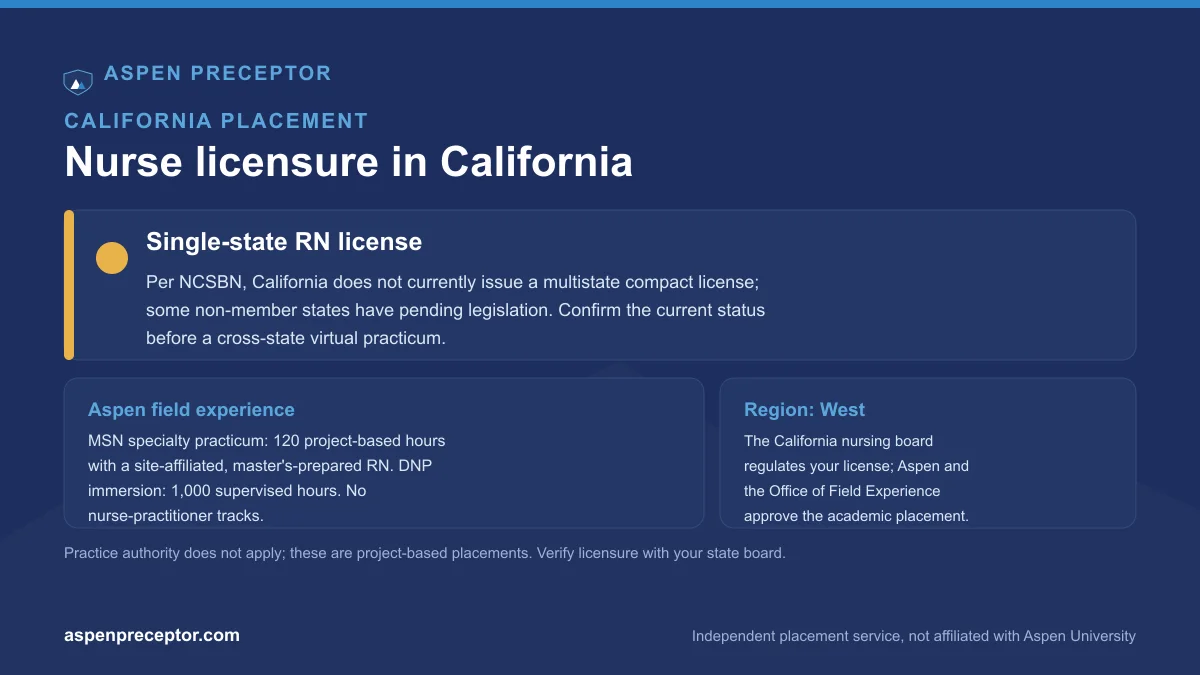
Aspen placements in California are approved project-based specialty practicums, undergraduate field experiences, or DNP immersions. They are not NP clinical rotations because Aspen University does not currently offer nurse practitioner tracks.
Get matched, free
Tell us your program and we’ll start the search. No payment until you’re matched.
Choose a department, not just a recognizable facility
California's size creates many possible settings, but a famous organization is not automatically a good academic site. Los Angeles and the Inland Empire have extensive health-system education, administration, quality, informatics, public-health, correctional, and community programs. San Diego offers health-system, public-sector, and education settings. Sacramento can support public-health and organizational projects. The Bay Area includes clinical systems, nursing education, technology, and quality teams, while Fresno, Bakersfield, Stockton, and communities across the Central Valley can offer regional and population-focused work.
The student's Aspen specialty should narrow this map. Administration and Management may fit nursing operations, quality, safety, or leadership. Informatics often belongs with clinical applications, nursing informatics, or health-information workflow. Nursing Education can involve competency, staff development, simulation, or patient education. Public Health projects may connect to county programs or community prevention. Forensic Nursing needs appropriate expertise and may fit trauma, correctional health, advocacy, or another relevant service.
California nursing regulation is not Aspen placement approval
The California Board of Registered Nursing regulates registered nursing practice and education and issues RN licenses in California. Its official site provides license verification, statutes and regulations, enforcement information, and guidance on nursing practice. Students should use the BRN when a question concerns California licensure or the professional scope of the student or proposed RN preceptor.
Aspen University and the Office of Field Experience, or OFE, decide whether the academic proposal meets program requirements. The BRN does not select an Aspen project or issue a Practicum Approval Letter. Aspen's MSN preceptor is a site-affiliated RN with a master's degree and specialty-relevant expertise. A California organization may separately require onboarding, privacy training, health clearance, data review, or an affiliation process.
Bring enough detail to earn a useful response
Large California systems receive many student requests. A general message asking for any nursing preceptor is easy to misroute. A better request names Aspen University, explains that the placement is project-based, identifies the specialty, summarizes the project purpose, states the course dates and hours, and describes the preceptor qualifications. It should also state that the university and site must approve the arrangement before work begins.
When possible, contact the department that owns the work. A San Diego informatics student might seek nursing informatics or clinical applications rather than a unit manager. A Sacramento Public Health student may focus on a county or community program. An Administration student in Los Angeles can ask quality, patient safety, or nursing operations. This approach also makes it easier to explain what access, meetings, and deliverables the project requires.
- Confirm the RN is employed by or formally affiliated with the proposed site.
- Verify the master's degree and relevant specialty or project experience.
- Ask whether the department can support the full course period and activity mix.
- Identify the person or office that reviews student agreements and project access.
Fit 120 hours to the specialty requirements
Each Aspen MSN specialty includes a 120-hour practicum. Administration and Management uses 40 hours in N550 and 80 hours in N586AM. Forensic Nursing, Nursing Education, and Public Health include at least 20 direct-care hours within the 120. Informatics and Administration do not have that direct-care minimum. A California site should be able to support the specific activities, not simply provide space for the required amount of time.
RN-to-MSN students complete undergraduate field experience before their graduate practicum, so their field plan extends beyond the final 120 hours. RN-to-BSN students have a published course breakdown of 30 hours in N492, 80 in N493, and 10 in N496. Those courses add to 120, while Aspen's catalog heading says 110. Students should confirm the applicable catalog rather than state one total as universally controlling.
OFE paperwork establishes permission to begin
OFE assists with placement questions, approvals, and identifying alternative locations. Many students explore a current workplace, which may simplify access but does not waive academic or facility review. Materials can include a Site Affiliation or Practicum Site Agreement, a signed Preceptor Agreement, preceptor CV and license report, student license report, Student Profile, and student CV. California sites may have their own contract or project-review documents.
The student must receive the applicable Practicum Approval Letter before beginning hours. Once underway, approved hours and required reports are recorded in ProjectConcert. It is useful to review entries weekly with the project plan and course objectives, particularly when a project includes meetings, document development, teaching, observation, and direct-care components. The workplace practicum guide can help students evaluate an employer-based option.
DNP immersion requires a durable California partnership
The Aspen DNP includes 1,000 supervised immersion hours divided among eight 125-hour courses. Aspen may approve and bank up to 500 verified prior precepted hours. The DNP needs an approved site and an on-site, doctoral-prepared, site-affiliated preceptor whose leadership and project expertise fit the student's work. A project spanning several courses calls for a conversation about long-term access and preceptor availability before the first agreement is signed.
IRB approval is required before data collection or analysis. A health system, county agency, or other California organization may also conduct its own review to classify and authorize the work. Our service offers Aspen students in-person and virtual practicum routes in California. Before starting, confirm the proposed format, site, preceptor, and planned activities with Aspen and the Office of Field Experience for your individual program and course. DNP students should also follow Aspen's current on-site preceptor and project approval requirements.
Support when California outreach has stalled
If the proposed department cannot provide a qualified preceptor, our independent service can help source another California possibility and organize the information for university review. We never guarantee a placement or Aspen approval. Students pay only when matched. Request a free placement review with the specialty, California region, project focus, and expected start. Pricing is reserved for the cost page.
Frequently asked questions
Is the California BRN responsible for Aspen site approval?
No. The BRN regulates California RN licensure and nursing practice. Aspen and OFE decide whether the proposed academic site, preceptor, documentation, and project are acceptable.
Can an Aspen California practicum take place at work?
A workplace may be suitable if the department, project, and preceptor fit the program. The student still needs site cooperation, Aspen review, and the applicable approval letter before hours begin.
Does every Aspen MSN specialty require direct-care hours?
No. Forensic Nursing, Nursing Education, and Public Health include at least 20 direct-care hours within the 120-hour practicum. Informatics and Administration do not have that minimum.
Does your service offer in-person and virtual practicum routes in California?
Our service offers Aspen students in-person and virtual practicum routes in California. Before starting, confirm the proposed format, site, preceptor, and planned activities with Aspen and the Office of Field Experience for your individual program and course. DNP students should also follow Aspen's current on-site preceptor and project approval requirements.
Get your Aspen practicum handled.
Tell us your program and specialty. We’ll map your field-experience requirement and start the search, in person or virtual. No payment until you’re matched.