Build your Aspen practicum plan in Florida
An Aspen placement in Florida is a specialty-aligned practicum or DNP immersion experience, not a nurse practitioner rotation. The right plan connects your project, prospective site, preceptor credentials, and OFE approval before any hours begin.
Get matched, free
Tell us your program and we’ll start the search. No payment until you’re matched.
What an Aspen placement means in Florida
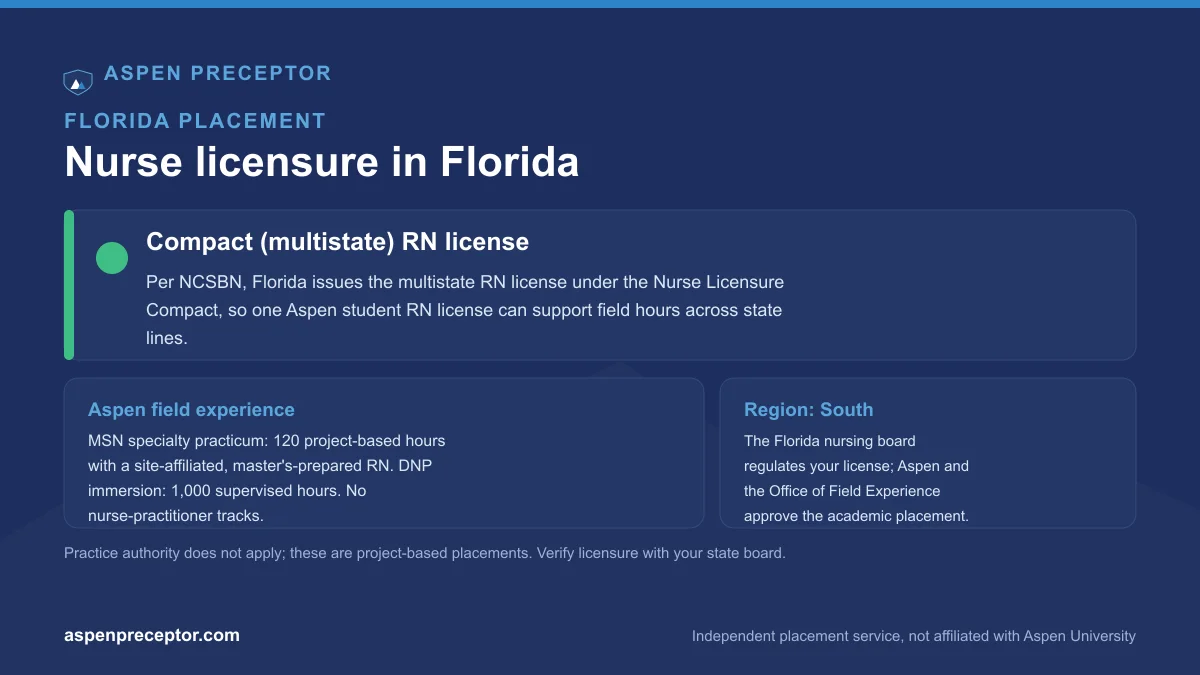
Aspen's graduate nursing pathways focus on quality improvement, leadership, education, informatics, public health, and forensic nursing. Aspen currently offers no nurse practitioner track, so Florida practice-authority categories for advanced practice nurses do not define these placements. A student is looking for a setting where the practicum project can be completed with appropriate access, organizational support, and qualified supervision.
For an MSN student, that usually means a 120-hour specialty practicum with a site-affiliated RN who has a master's degree and relevant expertise. Administration students divide the requirement between 40 hours in N550 and 80 hours in N586AM. Nursing Education, Public Health, and Forensic Nursing students include at least 20 direct-care hours within their 120. Informatics and Administration do not carry that direct-care minimum. Your current course documents remain the controlling source.
How the Florida Board of Nursing fits the process
The Florida Board of Nursing is the state regulator for nursing licenses. Its official site is the proper place to check license status, renewal information, discipline records, and Florida nursing rules. A prospective RN preceptor should have a license and professional standing that fit the role Aspen will review. The Board does not choose your academic project or issue Aspen's practicum approval letter.
That division of responsibility matters. Florida regulates the nursing license and local practice. Aspen's Office of Field Experience evaluates whether the proposed site, preceptor, agreements, and student materials satisfy the academic placement requirements. A facility may also impose its own onboarding, privacy, health, background, or education-office conditions. Treat all three reviews as separate checkpoints rather than assuming that one approval covers the others.
Where a Florida search can start
Florida offers several distinct search markets. Miami and Fort Lauderdale have large health systems, public agencies, community organizations, and health-information operations. Orlando and Tampa have hospital networks, education departments, quality teams, and regional public-health partners. Jacksonville, Tallahassee, Gainesville, Fort Myers, and Pensacola can support more focused searches through county health departments, universities, correctional health programs, community clinics, and long-term care organizations.
The best list follows the specialty. An Informatics project may fit an HIM, clinical systems, documentation, or data-quality team. Nursing Education may fit staff development or continuing education. Public Health students can explore county programs, school health, prevention initiatives, or community agencies. Administration students need leadership access and an operational question. Forensic Nursing students may consider emergency services, corrections, medical examiner partnerships, or victim-support programs when the project and required direct-care element align.
- Start with organizations where you already have a professional relationship, but confirm that the project is distinct from routine job duties.
- Ask whether the proposed preceptor is employed by or formally affiliated with the site and can document relevant expertise.
- Describe a practical quality-improvement question before asking a busy leader to supervise an undefined practicum.
- Keep a second Florida region in reserve if the preferred city has limited specialty capacity.
Turn 120 hours into a workable calendar
A 120-hour requirement becomes easier to evaluate when it is tied to real work phases. Early hours may support stakeholder meetings, evidence review, baseline assessment, and project design. Middle weeks may include education, workflow observation, implementation tasks, or direct-care activity where the specialty requires it. Later hours can support evaluation, reporting, reflection, and closeout. The preceptor does not have to stand beside the student for every project task, but the site relationship and supervision still need to meet Aspen's rules.
Build around Florida realities such as hurricane planning, holiday staffing, seasonal census changes, school calendars, and facility onboarding. Do not assume that a verbal yes means the calendar is ready. Confirm the course dates, expected weekly availability, direct-care component, access to needed data, and who can sign records. Hours completed before the applicable approval letter may not count, so the safest schedule begins after written OFE clearance.
RN-to-MSN, RN-to-BSN, and DNP differences
RN-to-MSN students should plan for undergraduate field experience as well as the later 120-hour graduate practicum. For RN-to-BSN, the current handbook lists N492 at 30 field hours, N493 at 80, and N496 at 10. Those course figures add to 120, while the current catalog heading states 110 field hours. Confirm which catalog and handbook govern your enrollment rather than building a Florida site plan around a single assumed total.
DNP planning is larger in scope. The program includes 1,000 supervised immersion hours across eight courses with 125 hours each. Aspen may approve and bank up to 500 verified prior precepted hours. The current DNP requires an approved site and an on-site, doctoral-prepared preceptor affiliated with that site who has relevant leadership and project knowledge. IRB approval is required before data collection or analysis, so a DNP search must consider project feasibility, organizational permission, data access, and the approval sequence together.
OFE paperwork and ProjectConcert
Aspen's Office of Field Experience assists with placement questions, reviews prospective arrangements, and can discuss alternatives. The approval packet may include a Site Affiliation or Practicum Site Agreement, a physically signed Preceptor Agreement, the preceptor's CV and license report, the student's license report, Student Profile, and student CV. Site-specific screening may add time. The Student Performance Evaluation is a later evaluation tool, not a substitute for the initial approval documents.
Wait for the applicable Practicum Approval Letter or DNP Immersion Approval Letter before starting. Students use ProjectConcert for required hour records, reports, and evaluations. Record work promptly and describe it accurately. If the Florida site, supervisor, project access, or schedule changes, contact OFE before continuing under a different arrangement. This protects both the academic record and the working relationship with the site.
In-person and virtual practicum routes in Florida
Our service offers Aspen students in-person and virtual practicum routes in Florida. Before starting, confirm the proposed format, site, preceptor, and planned activities with Aspen and the Office of Field Experience for your individual program and course. DNP students should also follow Aspen's current on-site preceptor and project approval requirements.
If your Florida outreach has stalled, our independent service can review the specialty, location, timing, preceptor credentials, and paperwork gaps, then source a prospective match for Aspen to review. We do not guarantee placement or approval. Request a free placement review to see whether a workplace option, nearby city, or broader Florida search is the most practical next step.
Frequently asked questions
Does Florida approve my Aspen practicum site?
Florida regulates nursing licenses and practice, but Aspen's Office of Field Experience decides whether a proposed site and preceptor meet academic requirements. The facility may have separate onboarding requirements as well.
Can I use my Florida workplace for the Aspen practicum?
Possibly. Many students explore a workplace setting, but the project, preceptor, site relationship, agreements, and separation from routine duties still need OFE review and written approval.
Does your service offer in-person and virtual practicum routes in Florida?
Our service offers Aspen students in-person and virtual practicum routes in Florida. Before starting, confirm the proposed format, site, preceptor, and planned activities with Aspen and the Office of Field Experience for your individual program and course. DNP students should also follow Aspen's current on-site preceptor and project approval requirements.
When should I begin recording Florida practicum hours?
Begin only after you receive the applicable Practicum Approval Letter or DNP Immersion Approval Letter. Then maintain required records and reports in ProjectConcert according to your course instructions.
Get your Aspen practicum handled.
Tell us your program and specialty. We’ll map your field-experience requirement and start the search, in person or virtual. No payment until you’re matched.