Find the right Indiana setting for your Aspen project
Aspen students in Indiana are pairing a specialty project with a qualified site and preceptor, not seeking NP clinical rotations. The match must work academically, professionally, and operationally before OFE can approve it.
Get matched, free
Tell us your program and we’ll start the search. No payment until you’re matched.
Explain the practicum before requesting a preceptor
Aspen's graduate nursing offerings are non-NP programs. The five MSN specialties are Administration and Management, Forensic Nursing, Informatics, Nursing Education, and Public Health. Their practica focus on quality improvement and specialty application in a practice environment. A clear Indiana request should name the specialty, project idea, course dates, and expected access rather than asking generally for clinical hours.
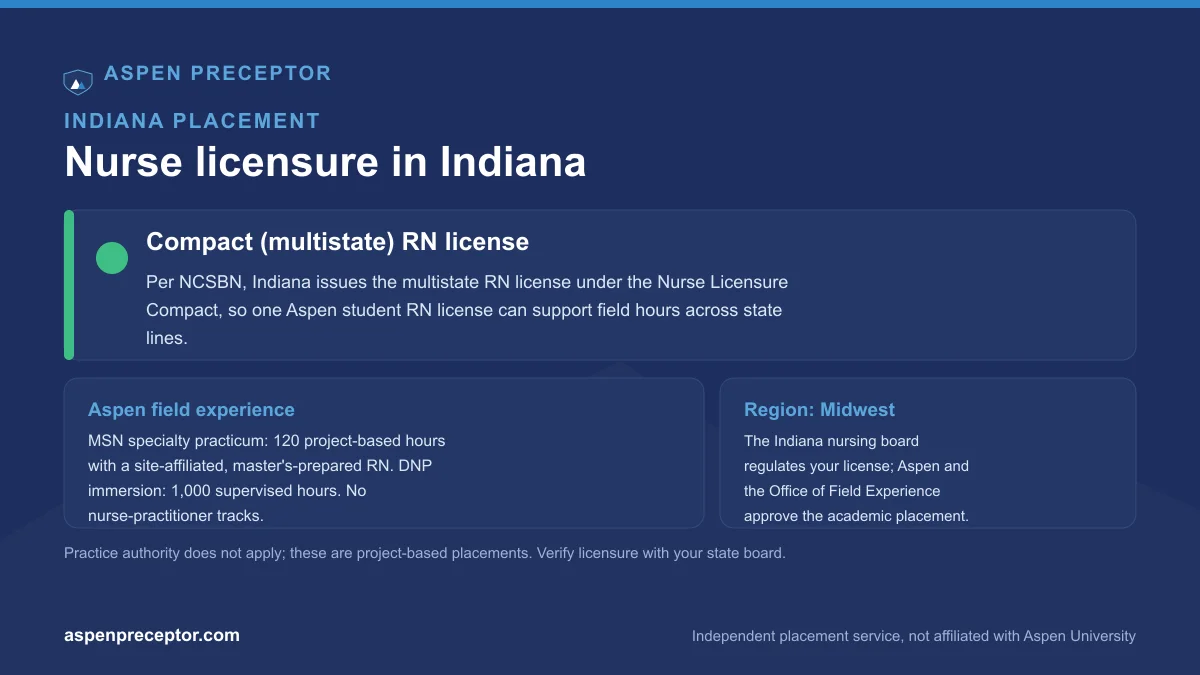
Each MSN specialty requires 120 hours under a site-affiliated RN who has a master's degree and relevant expertise. Administration splits the requirement between 40 hours in N550 and 80 in N586AM. Nursing Education, Public Health, and Forensic Nursing include a 20-hour minimum of direct care within the 120. Informatics and Administration do not have that direct-care minimum, although both require a real setting and approved supervision.
The Indiana nursing regulator checks licensure
The Indiana Professional Licensing Agency hosts the Indiana State Board of Nursing resources. Its official site provides nursing application, statute, rule, and license-service information. Verify a prospective RN preceptor through the state system and collect the documentation OFE requests instead of relying only on a badge, résumé, or directory listing.
The State Board of Nursing regulates professional licensure, not Aspen's academic placement. OFE evaluates the proposed preceptor, site, agreements, and project against program requirements. The Indiana organization controls facility access and can require education-office review, affiliation paperwork, privacy or security training, health records, background checks, and project authorization. A complete timeline respects all three roles.
Use Indiana's regional health networks thoughtfully
Indianapolis has the broadest concentration of health systems, state agencies, associations, education teams, administrative departments, and informatics operations. Fort Wayne, South Bend, Elkhart, Evansville, Terre Haute, Lafayette, Bloomington, and the northwest Indiana communities connect students with regional hospitals, public-health units, schools, long-term care, corrections, and community organizations.
A specialty-led search is more efficient than a list of every facility. Public Health may fit county health departments, school-health programs, prevention initiatives, or community agencies. Nursing Education may fit staff development and continuing education. Informatics can fit HIM, clinical applications, workflow, or data-quality teams. Administration needs leadership access. Forensic Nursing may fit emergency, correctional, court, law enforcement, or victim-support settings when direct-care and privacy requirements can be met.
Before an Indiana site says yes
- Confirm the proposed preceptor is formally connected to the location where the project will occur.
- Ask whether an affiliation agreement already exists or must be reviewed from the beginning.
- Identify who can authorize access to staff, workflow information, or project data.
- Set an alternate weekly schedule for weather, staffing changes, and organizational events.
Translate 120 hours into an organization-friendly plan
The project calendar may include evidence review, stakeholder meetings, assessment of current practice, intervention planning, approved implementation work, education, evaluation, and reporting. Those activities should connect to the Aspen specialty and the site's priorities. For the specialties with a direct-care minimum, the plan needs to show where those 20 hours occur and who verifies them.
A preceptor does not need to be physically beside an MSN student for every approved task, but supervision and site affiliation remain essential. Confirm availability for meetings, feedback, and signatures. Indiana systems may use fixed student-placement cycles, while smaller organizations may need more explanation of the agreement. Do not begin hours simply because a manager supports the idea. Written OFE approval comes first.
Bridge, completion, and doctoral students need distinct plans
RN-to-MSN students complete undergraduate field experience and later the 120-hour specialty practicum. A single Indiana employer might support both only if each phase meets its own outcomes and approval requirements. For RN-to-BSN, the current handbook lists N492 at 30 field hours, N493 at 80, and N496 at 10. The course list adds to 120, while the catalog heading says 110. Confirm the governing version before giving a site a total-hours request.
DNP students complete 1,000 supervised immersion hours in eight 125-hour courses. Up to 500 verified prior precepted hours may be approved and banked. The DNP requires an on-site, doctoral-prepared professional who is affiliated with the site and has healthcare leadership and project-topic expertise. The site must support the project and data plan, and Aspen IRB approval must precede any data collection or analysis.
Assemble the OFE packet and protect the record
Aspen's Office of Field Experience assists with placement questions, approval, and alternative-site discussions. Current documents may include the Site Affiliation or Practicum Site Agreement, a physically signed Preceptor Agreement, the preceptor CV and license report, the student license report, Student Profile, and student CV. The Indiana facility may add its own items. The Student Performance Evaluation is used later and is not an initial approval document.
Wait for the Practicum Approval Letter or DNP Immersion Approval Letter before beginning. After approval, ProjectConcert supports required hour documentation, reports, and evaluations. If a preceptor leaves, a department reorganizes, or project access moves to another legal facility, contact OFE before continuing. An operational change can affect the arrangement even when the student's topic stays the same.
In-person and virtual practicum routes in Indiana
Some MSN tasks, including approved research, planning, analysis, and writing, may occur away from the Indiana site. Aspen students in Indiana can use our service for either an in-person or virtual practicum route. Ask Aspen and the Office of Field Experience to confirm the format, site, preceptor, and activities for your individual program and course before any hours begin. DNP students should follow Aspen's current on-site preceptor and project approval requirements.
When your Indiana search is stalled by a narrow specialty, affiliation timing, or a long commute, our independent service can review the complete request and source a prospective match for Aspen to assess. We cannot guarantee placement or approval. Send a free placement review to compare an employer-based proposal, a nearby regional market, and other specialty-appropriate settings.
Frequently asked questions
Is an Aspen placement in Indiana a nurse practitioner rotation?
No. Aspen currently offers no nurse practitioner tracks. Its MSN and RN-to-MSN experiences are specialty project practicums, and its DNP uses supervised immersion tied to a practice-improvement project.
Can I use an Indiana workplace as the site?
It may be suitable when the project is educationally distinct, the organization supports it, a qualified site-affiliated preceptor is identified, and OFE approves all required materials before hours begin.
Who approves the preceptor's Indiana license?
The state licensing system establishes license status. OFE separately evaluates whether the license, graduate degree, specialty expertise, site connection, and project meet Aspen requirements.
Does your service offer in-person and virtual practicum routes in Indiana?
Aspen students in Indiana can use our service for either an in-person or virtual practicum route. Ask Aspen and the Office of Field Experience to confirm the format, site, preceptor, and activities for your individual program and course before any hours begin. DNP students should follow Aspen's current on-site preceptor and project approval requirements.
Get your Aspen practicum handled.
Tell us your program and specialty. We’ll map your field-experience requirement and start the search, in person or virtual. No payment until you’re matched.