Build an Ohio practicum around your Aspen specialty
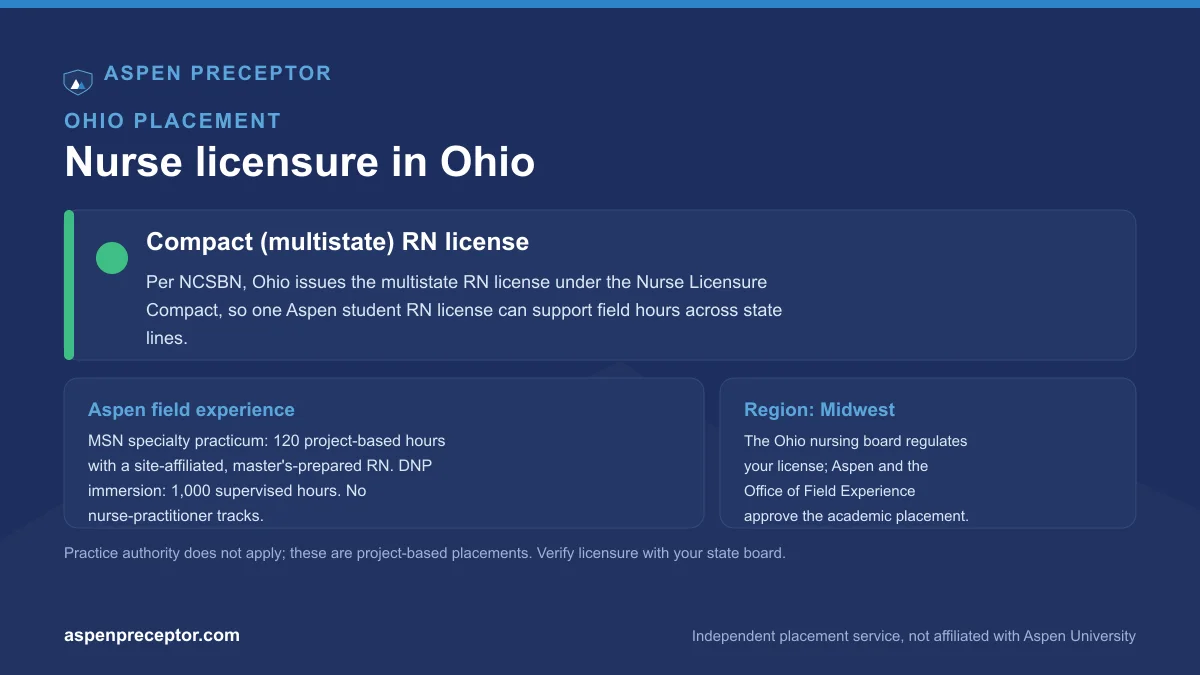
An Aspen placement in Ohio is supervised work on an approved specialty project, field experience, or DNP immersion. It should not be presented as an NP clinical rotation because Aspen University currently has no NP tracks.
Get matched, free
Tell us your program and we’ll start the search. No payment until you’re matched.
Use the specialty to narrow a large Ohio market
Columbus has health systems, public-health programs, education teams, informatics departments, quality offices, and administrative units. Cleveland and Akron offer academic and regional health, staff development, clinical technology, quality, and community settings. Cincinnati and Dayton add hospital, education, administration, and population-health possibilities. Toledo, Youngstown, and other regional centers can support practical projects when the department and preceptor fit.
Aspen's MSN specialties are Administration and Management, Forensic Nursing, Informatics, Nursing Education, and Public Health. Education may align with competency, simulation, or patient teaching. Informatics can fit clinical applications and workflow. Administration often connects to operations, safety, or quality. Public Health can involve prevention and community programming. Forensic Nursing requires a relevant specialty site, such as an appropriate trauma, correctional health, or advocacy service.
Students between major metros can search regional systems and county programs rather than limiting outreach to one distant academic center. The deciding factors remain project access, appropriate nursing expertise, supervision, and the site's willingness to complete the approval process.
Ohio's Board answers licensing and practice questions
The Ohio Board of Nursing regulates nursing licensure, education, and practice and provides official license services, verification, laws and rules, discipline, and professional guidance. Students and proposed preceptors should use the Board for Ohio nursing-regulation questions.
Aspen University and the Office of Field Experience, or OFE, decide whether an academic site, preceptor, project, and documents meet the program. The Ohio Board does not issue an Aspen approval letter. The host organization also controls its own onboarding, privacy, access, and project-review rules.
Make the first site request easy to assess
A concise request should name Aspen University, state that the practicum is project-based, identify the specialty, summarize the project, provide dates and hours, and describe the required preceptor credentials. It should explain that Aspen and the Ohio site must approve the arrangement before any hours begin.
For an MSN practicum, the proposed preceptor should be a site-affiliated RN with a master's degree and expertise relevant to the specialty. Ask about the degree, license, current role, project experience, availability, and permission to precept. A department also needs enough access and resources to support the planned work through the course.
- Contact the department that owns the project rather than a general switchboard.
- Describe required direct-care activity when applicable.
- Ask who signs agreements and reviews project or data access.
- Share a realistic calendar with regular preceptor check-ins.
Use the correct Aspen hour structure
Each Aspen MSN specialty includes 120 practicum hours. Administration and Management separates them into N550 at 40 hours and N586AM at 80. Forensic Nursing, Nursing Education, and Public Health include at least 20 direct-care hours within the total. Informatics and Administration have no direct-care minimum. The activity plan should reflect the correct specialty rather than generic observation.
RN-to-MSN students complete undergraduate field experience before their graduate practicum, so 120 graduate hours are not the whole field sequence. RN-to-BSN students should confirm the applicable catalog. N492 lists 30 hours, N493 lists 80, and N496 lists 10, adding to 120, while Aspen's catalog heading says 110. Direct guidance should control the student's schedule.
OFE review establishes the official start
OFE assists with placement questions, approval, documentation, and alternative locations. Many Ohio students explore their workplace, but a workplace site remains subject to review. The file can include a Site Affiliation or Practicum Site Agreement, signed Preceptor Agreement, preceptor CV and license report, student license report, Student Profile, and student CV. Facility documents may be added.
Do not begin hours before receiving the applicable Practicum Approval Letter. After approval, hours and required reports are recorded in ProjectConcert. Students should review entries against the approved project and course objectives each week. The practicum approval guide explains the sequence from tentative match to countable activity.
DNP immersion needs on-site doctoral guidance
Aspen DNP students complete 1,000 supervised immersion hours across eight courses of 125 hours each. Aspen may approve and bank up to 500 verified prior precepted hours. An Ohio DNP site requires an on-site, doctoral-prepared, site-affiliated preceptor with leadership and project expertise. Multi-course continuity should be discussed before the placement begins.
IRB approval is required before data collection or analysis, and the organization may conduct its own project review. We offer both in-person and virtual practicum routes for Aspen students seeking support in Ohio. Before the experience begins, confirm the intended format, site, preceptor, and planned activities with Aspen and the Office of Field Experience for your program and course. Follow the current DNP-specific on-site preceptor and project approval requirements when they apply.
Independent sourcing help in Ohio
If employer and direct outreach have not produced a qualified match, our independent service can help source a possible Ohio preceptor and organize match information for Aspen review. We do not guarantee placement or approval. Students pay only when matched. Submit a free placement review with the Ohio region, specialty, project, and course date. Pricing appears only on the cost page.
Frequently asked questions
Is an Aspen Ohio placement an NP clinical rotation?
No. Aspen currently offers no NP tracks. Its Ohio placements support specialty projects, undergraduate field experience, or DNP immersion.
Does the Ohio Board approve my Aspen preceptor?
No. The Board regulates Ohio nursing licenses and practice. Aspen and OFE make the academic approval decision for the site and preceptor.
Can my Ohio employer host the practicum?
It may be proposed when the department, project, and preceptor fit the program. Site cooperation and the applicable Aspen approval letter are still required.
Does your service offer in-person and virtual practicum routes in Ohio?
We offer both in-person and virtual practicum routes for Aspen students seeking support in Ohio. Before the experience begins, confirm the intended format, site, preceptor, and planned activities with Aspen and the Office of Field Experience for your program and course. Follow the current DNP-specific on-site preceptor and project approval requirements when they apply.
Get your Aspen practicum handled.
Tell us your program and specialty. We’ll map your field-experience requirement and start the search, in person or virtual. No payment until you’re matched.