Shape an Aspen Practicum Around a Tennessee Site
An Aspen placement in Tennessee is a locally approved, project-based specialty practicum or supervised DNP immersion, not a nurse practitioner rotation. Begin by defining the project and required preceptor, then approach a Tennessee department that can support the work and complete Aspen's approval process.
Get matched, free
Tell us your program and we’ll start the search. No payment until you’re matched.
Choose the Tennessee setting by project function
Nashville has health systems, education departments, public-health and state-government offices, quality teams, and health technology operations. Memphis adds academic and community health settings, advocacy programs, public agencies, informatics departments, and large system administration. Knoxville and Chattanooga provide regional hospitals, universities, schools, nonprofits, and workforce-development teams.
The Tri-Cities area around Johnson City, Kingsport, and Bristol can support projects serving northeast Tennessee and the Appalachian region. Jackson and Cookeville can anchor searches in west and middle Tennessee outside the largest metros. In any region, search for the office that owns the issue in your project, such as professional development for Nursing Education, HIM or clinical applications for Informatics, or a county health department for Public Health.
Describe Aspen's work accurately
Aspen University currently offers no nurse practitioner tracks. Its five MSN specialties are Administration and Management, Forensic Nursing, Informatics, Nursing Education, and Public Health. Each has a 120-hour project-based practicum. The MSN preceptor is a site-affiliated RN with a master's degree and expertise relevant to the specialty. Asking a Tennessee organization for an NP rotation can send the request to the wrong staff and create confusion about the activity.
Forensic Nursing, Nursing Education, and Public Health include at least 20 direct-care hours within the 120. Informatics and Administration do not have that direct-care minimum. Administration divides its practicum between N550 at 40 hours and N586AM at 80 hours. Give the site a concise project purpose, access request, hour structure, dates, and preceptor qualifications.
The Tennessee Board regulates the nurse
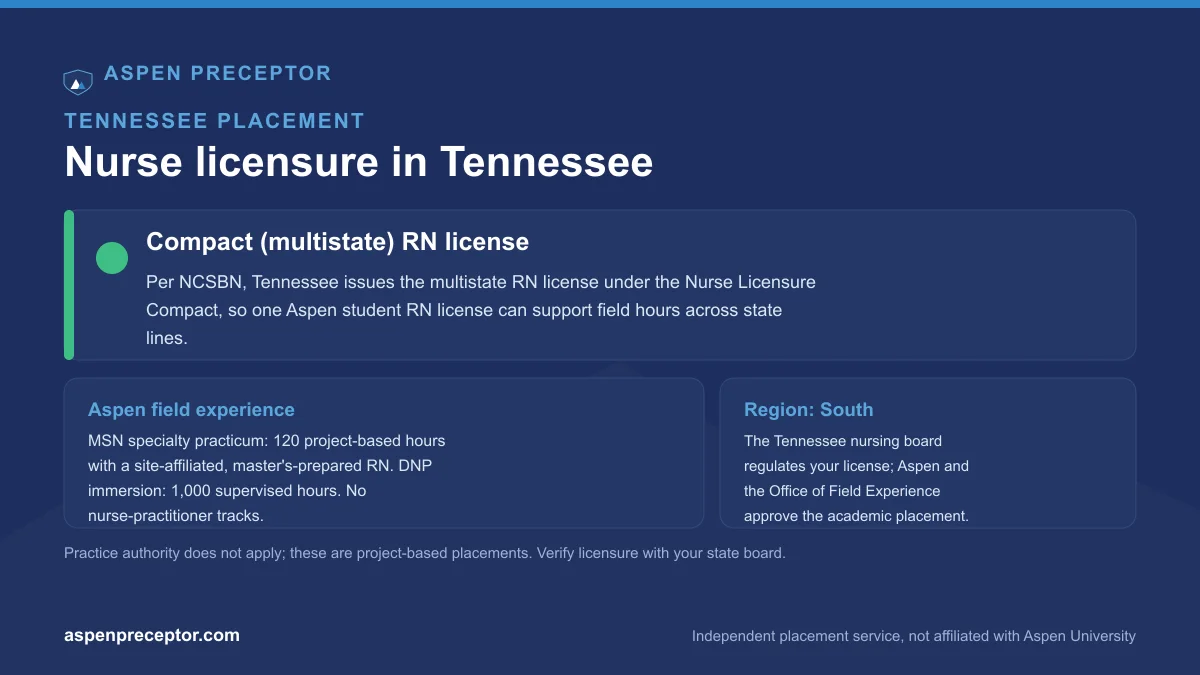
The Tennessee Board of Nursing, within the Department of Health, regulates nursing licensure, education, and practice in the state. Its official page provides license verification, applications and renewals, rules, policies, meeting information, and education resources. Use official verification to confirm a proposed preceptor's Tennessee RN license, then include the result with the CV and license report used in Aspen's process.
The Board does not select an Aspen site or approve the specialty project. Aspen and the Office of Field Experience decide whether the preceptor, site, project, schedule, and documents meet academic requirements. The Tennessee organization separately decides whether it can host the student and authorize access. Keep the regulatory, site, and academic decisions in their proper lanes.
Build a schedule that reflects the actual program
RN-to-MSN students complete undergraduate field experience and later the 120-hour graduate practicum. A Tennessee plan should identify which stage and course needs the placement rather than treating the graduate work as the student's only field requirement. RN-to-BSN course figures are N492 at 30 hours, N493 at 80 hours, and N496 at 10 hours. Those total 120, while an Aspen catalog heading states 110. Confirm the applicable catalog and current course instructions.
DNP students complete 1,000 supervised immersion hours in eight 125-hour courses. Up to 500 verified prior precepted hours may be approved and banked. The DNP arrangement requires an approved site and an on-site, doctoral-prepared, site-affiliated preceptor with relevant leadership and project expertise. Ask whether supervision and project access can continue across the planned sequence.
Move a workplace lead through approval
Many Tennessee students first explore their workplace. Existing relationships can make the right department easier to reach, but employment does not replace a defined project, organizational permission, or Aspen review. Approval materials can include a Site Affiliation or Practicum Site Agreement, signed Preceptor Agreement, preceptor CV and license report, student license report, Student Profile, and student CV.
OFE assists with placement questions, approvals, paperwork, and alternative locations. Wait for the applicable Practicum Approval Letter or DNP Immersion Approval Letter before starting. After approval, record hours and required reports in ProjectConcert. DNP students must also receive IRB approval before data collection or analysis. The workplace practicum guide can help you frame the first conversation.
In-person and virtual practicum routes in Tennessee
Aspen students in Tennessee can use our service for either an in-person or virtual practicum route. Ask Aspen and the Office of Field Experience to confirm the format, site, preceptor, and activities for your individual program and course before any hours begin. DNP students should follow Aspen's current on-site preceptor and project approval requirements.
A Tennessee search with support
We can source Tennessee prospects that fit the specialty, project, location, and preceptor requirements, then help organize details for Aspen's review. We are an independent service. We assist but never guarantee placement or approval. Students pay only when matched, with pricing on the cost page. Tell us your region, program, project direction, and course timing in a free placement review.
Frequently asked questions
Does the Tennessee Board approve my Aspen practicum?
No. The Board regulates nursing licenses, education, and practice in Tennessee. Aspen and OFE separately review and approve the academic preceptor, site, project, schedule, and documents.
Can my Tennessee workplace host the project?
It may be considered if the project fits, the preceptor qualifies, the site agrees, and the required documents are complete. Wait for Aspen's applicable approval letter before beginning hours.
What does an Aspen MSN preceptor need in Tennessee?
The preceptor is a site-affiliated RN with a master's degree and expertise relevant to the student's specialty. Aspen reviews those qualifications with the rest of the placement.
Does your service offer in-person and virtual practicum routes in Tennessee?
Aspen students in Tennessee can use our service for either an in-person or virtual practicum route. Ask Aspen and the Office of Field Experience to confirm the format, site, preceptor, and activities for your individual program and course before any hours begin. DNP students should follow Aspen's current on-site preceptor and project approval requirements.
Get your Aspen practicum handled.
Tell us your program and specialty. We’ll map your field-experience requirement and start the search, in person or virtual. No payment until you’re matched.