Place an Aspen Nursing Project in Utah
An Aspen placement in Utah is a project-based specialty practicum or supervised DNP immersion, not a nurse practitioner rotation. The practical task is to connect the project to a Utah department, a qualified site-affiliated preceptor, and an approval packet that Aspen can review before hours begin.
Get matched, free
Tell us your program and we’ll start the search. No payment until you’re matched.
Start on the Wasatch Front, then work outward
Salt Lake City and the surrounding Wasatch Front offer health systems, universities, public agencies, informatics departments, quality offices, education teams, and community programs. Ogden and Provo add regional systems, academic partners, schools, and local public-health opportunities. Logan can anchor a northern Utah search, while St. George and Cedar City serve students in the south.
Students in central, eastern, or rural Utah can consider local health departments, regional hospitals, school systems, community organizations, and multi-site education or quality teams. Distance matters, but organizational fit comes first. Before expanding the radius, define what site access the project needs, how often you must be present, and whether the proposed preceptor can supervise the approved work across the course.
Use the specialty to identify the department
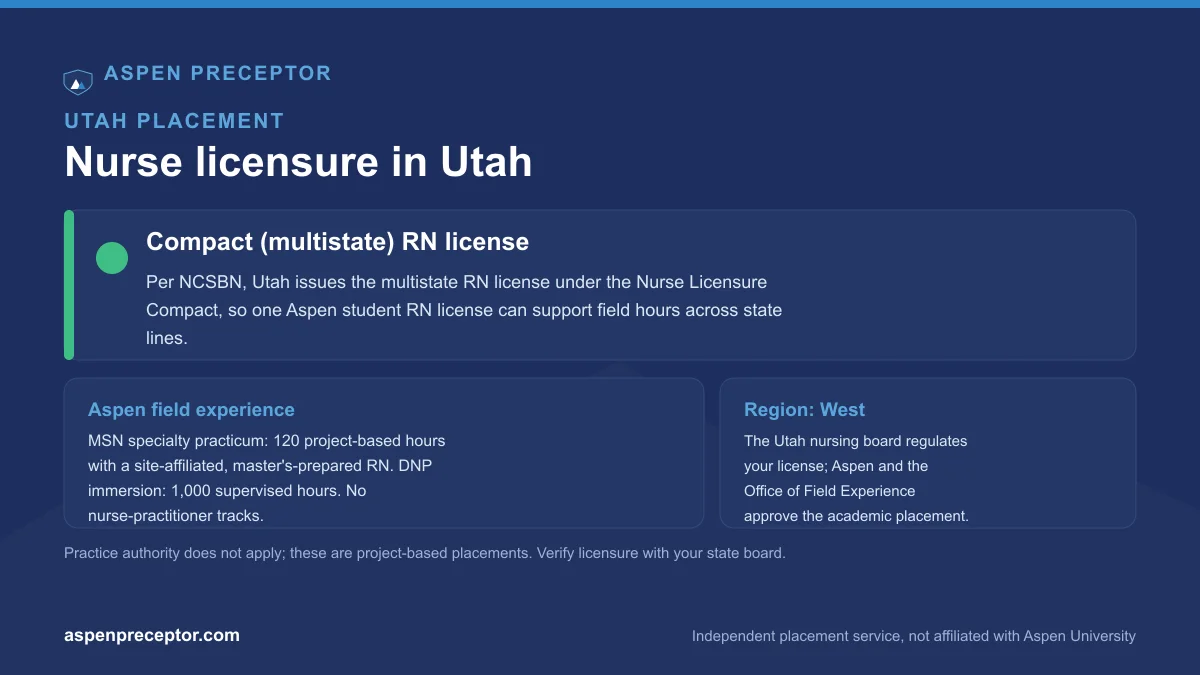
Aspen offers no nurse practitioner tracks. Its MSN specialties are Administration and Management, Forensic Nursing, Informatics, Nursing Education, and Public Health. Each requires a 120-hour project-based practicum with a site-affiliated RN who holds a master's degree and has relevant expertise. A Utah organization needs to hear the project request, not a generic request for clinical hours.
Nursing Education can fit staff-development, simulation, academic, or community-education teams. Informatics can fit EHR training, health information, clinical applications, data quality, or workflow groups. Administration can fit operations, quality, safety, or workforce departments. Public Health may fit local health departments, schools, community programs, or population-health teams. Forensic Nursing may fit advocacy, correctional health, emergency services, or multidisciplinary programs.
Utah DOPL handles the professional license
Nursing licensure in Utah is administered through the Division of Professional Licensing within the Department of Commerce, with the Utah Board of Nursing and Certified Nurse Midwives serving in the regulatory structure. The official nursing page provides license verification, applications, renewals, laws and rules, Board information, and public meetings. Use its verification link for a proposed Utah RN preceptor.
DOPL and the Board do not decide whether an Aspen project meets course requirements. Aspen and OFE review the academic placement, while the Utah organization decides whether it can host the work and complete agreements. Keep the official license result with the preceptor CV and license report, but wait for Aspen's full review before treating the person as approved.
Give every hour a credible setting
Forensic Nursing, Nursing Education, and Public Health include at least 20 direct-care hours within the 120 MSN hours. Informatics and Administration do not have that direct-care minimum. Administration divides the requirement between N550 at 40 hours and N586AM at 80 hours. Confirm that the Utah site can support the project activities and any direct-care component rather than agreeing only to the total.
RN-to-MSN students complete undergraduate field experience before the graduate 120-hour practicum. RN-to-BSN course figures are N492 at 30 hours, N493 at 80 hours, and N496 at 10 hours. They add to 120 while an Aspen catalog heading states 110. Ask the program which catalog and instructions apply before finalizing dates with a site.
Turn interest into an approval letter
Many Utah students explore their workplace. That can be a useful lead, but the project, preceptor, access, and separation from ordinary duties still need review. Approval materials can include a Site Affiliation or Practicum Site Agreement, signed Preceptor Agreement, preceptor CV and license report, student license report, Student Profile, and student CV.
OFE assists with placement questions, approvals, documents, and alternative locations. Wait for the applicable Practicum Approval Letter or DNP Immersion Approval Letter before beginning. Once approved, record hours and required reports in ProjectConcert. The OFE guide explains how the roles connect.
DNP work requires continuity and on-site leadership
Aspen DNP students complete 1,000 supervised immersion hours across eight 125-hour courses. Up to 500 verified prior precepted hours may be approved and banked. The Utah site needs an on-site, doctoral-prepared, site-affiliated preceptor with leadership and project expertise. Confirm the person's availability and the organization's support for the full project path.
IRB approval is required before data collection or analysis. A host may have additional internal reviews for access to staff, patients, records, or operational data. Obtain the required Aspen letter, IRB decision, and site permission before beginning any restricted activity.
In-person and virtual practicum routes in Utah
In-person and virtual practicum routes are both available through our service for Aspen students in Utah. Each student should confirm the proposed format, site, preceptor, and activities with Aspen and the Office of Field Experience before starting. DNP students must also follow Aspen's current on-site preceptor and project approval requirements.
Help with a Utah search
We can source Utah prospects based on specialty, project, region, travel limits, and preceptor qualifications, then help organize details for Aspen's review. We are an independent service. We never guarantee placement or approval. Students pay only when matched, with pricing on the cost page. Start a free placement review and share the Utah regions that are realistic for you.
Frequently asked questions
Does Utah DOPL approve an Aspen practicum?
No. DOPL and the nursing Board regulate professional licensure. Aspen and OFE separately review whether the preceptor, site, project, schedule, and documents meet academic requirements.
Can I search outside Salt Lake City?
Yes. Regional hospitals, health departments, schools, community programs, education teams, quality offices, and informatics departments may fit. Base the radius on project needs and sustainable travel.
Can my Utah employer serve as the site?
It may be considered, but the workplace still needs a suitable project, qualifying preceptor, organizational approval, completed documents, and Aspen's approval letter before hours begin.
Does your service offer in-person and virtual practicum routes in Utah?
In-person and virtual practicum routes are both available through our service for Aspen students in Utah. Each student should confirm the proposed format, site, preceptor, and activities with Aspen and the Office of Field Experience before starting. DNP students must also follow Aspen's current on-site preceptor and project approval requirements.
Get your Aspen practicum handled.
Tell us your program and specialty. We’ll map your field-experience requirement and start the search, in person or virtual. No payment until you’re matched.