Choose a Wisconsin Setting for Your Aspen Project
An Aspen placement in Wisconsin is a project-based MSN specialty practicum or supervised DNP immersion, not an NP rotation. The strongest proposal pairs a defined project with the Wisconsin department that owns the work, a qualified site-affiliated preceptor, and complete Aspen approval documents.
Get matched, free
Tell us your program and we’ll start the search. No payment until you’re matched.
Wisconsin has several useful project corridors
Milwaukee and nearby southeastern communities offer health systems, public-health departments, universities, community organizations, education teams, informatics departments, and administrative offices. Madison adds state government, academic settings, quality, research-support, and public-health opportunities. Green Bay and the Fox Valley, including Appleton and Oshkosh, provide regional systems, schools, nonprofits, and workforce programs.
Eau Claire, La Crosse, and Wausau can support projects through regional hospitals, academic partners, county agencies, and multi-site teams. Kenosha and Racine add southeastern options outside Milwaukee. Students farther north can consider community organizations, local health departments, schools, critical-access settings, and system-wide education or quality departments that work across multiple locations.
The Wisconsin Board verifies regulation, not course fit
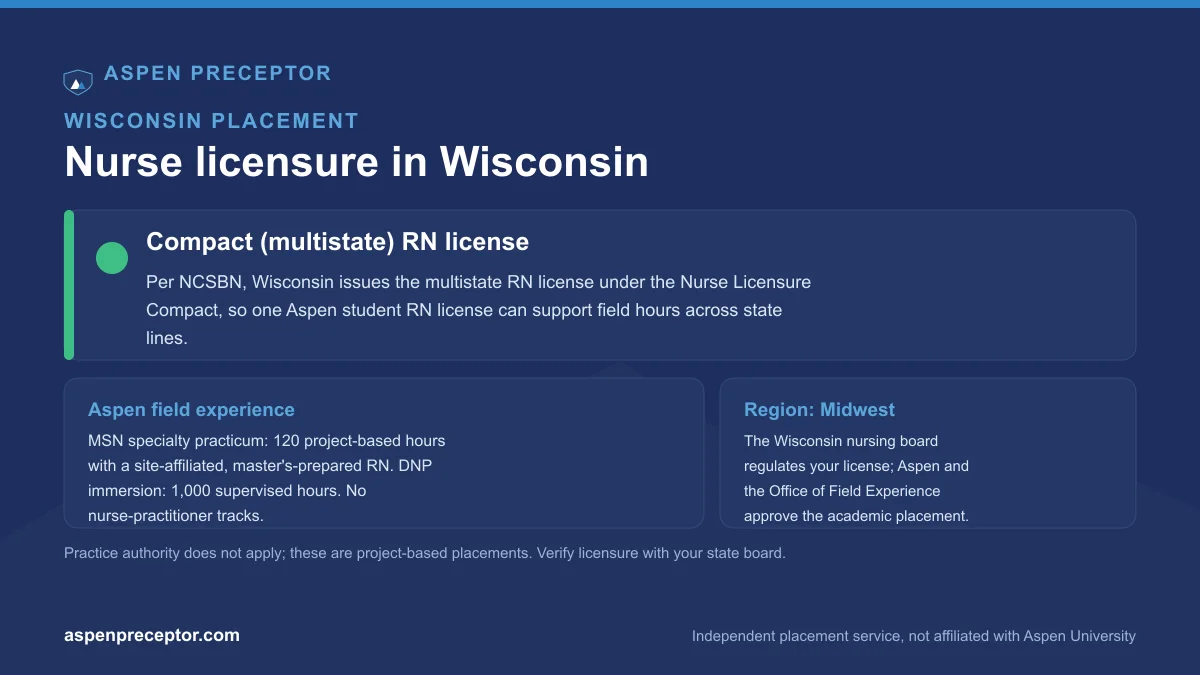
The Wisconsin Board of Nursing operates through the Department of Safety and Professional Services. Its official state page links to Board information, nursing resources, disciplinary orders, rules, and credential services. Use Wisconsin's official license lookup to verify a proposed RN preceptor and retain the result with the preceptor CV and license report.
The Board and DSPS do not approve an Aspen project or issue an academic approval letter. Aspen and OFE decide whether the site, preceptor, project, schedule, and documents meet program requirements. The Wisconsin organization separately decides whether it can host the project and authorize access. A valid license is one element of the placement, not the entire approval.
Use Aspen's specialty language from the first email
Aspen currently offers no nurse practitioner tracks. Its MSN specialties are Administration and Management, Forensic Nursing, Informatics, Nursing Education, and Public Health. Each requires 120 hours of project-based practicum work. The MSN preceptor must be a site-affiliated RN with a master's degree and expertise relevant to the specialty. That description should appear in the first serious request.
Nursing Education can fit professional-development, simulation, academic, or community-education teams. Informatics can fit EHR education, clinical applications, HIM, data quality, or workflow. Administration can fit quality, safety, workforce, care coordination, or operations. Public Health can fit local health departments, schools, agencies, or population-health programs. Forensic Nursing may fit advocacy, correctional health, emergency services, or multidisciplinary programs.
Give the site an activity plan
Forensic Nursing, Nursing Education, and Public Health include at least 20 direct-care hours within the 120 MSN hours. Informatics and Administration do not have that direct-care minimum. Administration divides the requirement between N550 at 40 hours and N586AM at 80 hours. A Wisconsin prospect should understand which activities are required and where they will occur.
RN-to-MSN students complete undergraduate field experience before the 120-hour graduate practicum. RN-to-BSN course figures are N492 at 30 hours, N493 at 80 hours, and N496 at 10 hours. They total 120 while an Aspen catalog heading says 110. Confirm the applicable catalog and current course directions before asking a site to reserve dates.
Identify the agreement owner early
Wisconsin systems may centralize student experiences, while smaller organizations may ask a director or administrator to review the agreement. Approval materials can include a Site Affiliation or Practicum Site Agreement, signed Preceptor Agreement, preceptor CV and license report, student license report, Student Profile, and student CV. Ask where each document belongs before transmitting it.
OFE assists with placement questions, approvals, paperwork, and alternative locations. Many students explore their workplace, but employment does not bypass the process. Wait for the applicable Practicum Approval Letter or DNP Immersion Approval Letter before starting, then record hours and required reports in ProjectConcert.
DNP sites must support the project sequence
Aspen DNP students complete 1,000 supervised immersion hours in eight 125-hour courses. Up to 500 verified prior precepted hours may be approved and banked. A Wisconsin DNP arrangement requires an approved site and an on-site, doctoral-prepared, site-affiliated preceptor with relevant leadership and project expertise. Confirm continued access and supervision.
IRB approval is required before data collection or analysis. A Wisconsin host may have its own project, privacy, or data review. Describe the proposed activity accurately and wait for all applicable approvals before the restricted work begins.
In-person and virtual practicum routes in Wisconsin
Our service offers Aspen students in-person and virtual practicum routes in Wisconsin. Before starting, confirm the proposed format, site, preceptor, and planned activities with Aspen and the Office of Field Experience for your individual program and course. DNP students should also follow Aspen's current on-site preceptor and project approval requirements.
A Wisconsin search with support
We can source Wisconsin prospects aligned with your specialty, project, region, travel range, and preceptor needs, then help organize details for Aspen's review. We are an independent service. We assist but cannot guarantee placement or approval. Students pay only when matched, with pricing on the cost page. Request a free placement review and share your preferred corridor.
Frequently asked questions
Does Wisconsin DSPS approve Aspen placements?
No. DSPS and the Board regulate professional licensing and practice. Aspen and OFE separately review whether the preceptor, site, project, schedule, and documents meet academic requirements.
Can I search outside Milwaukee and Madison?
Yes. Regional hospitals, county health departments, schools, community agencies, education departments, informatics teams, and quality offices throughout Wisconsin may fit.
Can my Wisconsin employer be the site?
It may be considered, but the project, preceptor qualifications, organizational permission, agreement, and relationship to normal duties still require review before approval.
Does your service offer in-person and virtual practicum routes in Wisconsin?
Our service offers Aspen students in-person and virtual practicum routes in Wisconsin. Before starting, confirm the proposed format, site, preceptor, and planned activities with Aspen and the Office of Field Experience for your individual program and course. DNP students should also follow Aspen's current on-site preceptor and project approval requirements.
Get your Aspen practicum handled.
Tell us your program and specialty. We’ll map your field-experience requirement and start the search, in person or virtual. No payment until you’re matched.